
Case study
Restaurant CRM: Your customer base is worth more than you think — up to €73,000 a year (a study of 1,709 restaurants across 18 countries)

Every restaurant that takes online orders builds something each day that never shows up at the till: a customer base — a list of people who once ordered, sometimes came back, and some of whom left consent to be contacted. This base never appears on your balance sheet, yet it has real, measurable value — and it grows every month you operate.
We analysed over 13 million orders from the past 12 years across 1,709 restaurants (595 separate brands) in 18 countries to show how much your base is worth and how to turn it into real money.
Results
A customer who comes back regularly is worth fourteen times more per year. An average one-time customer leaves ~€31 a year, while a loyal one (10+ orders) brings ~€420.
That's how many customers in an average restaurant's base order 10+ times. A narrow but most valuable group — and it grows over time (after 5+ years it's already 8%).
That's how many unique customers an average restaurant has in its base after 3–5 years.
That's what the base of ~2,890 customers is worth for an average restaurant operating 3–5 years — depending on how you measure it (three methods below).
That's the share of customers who give consent to email or SMS contact in restaurants operating 3–5 years.
A single location after 3–5 years has more than twice the base it had in its first 1–2 years (after 5+ years — more than three times).
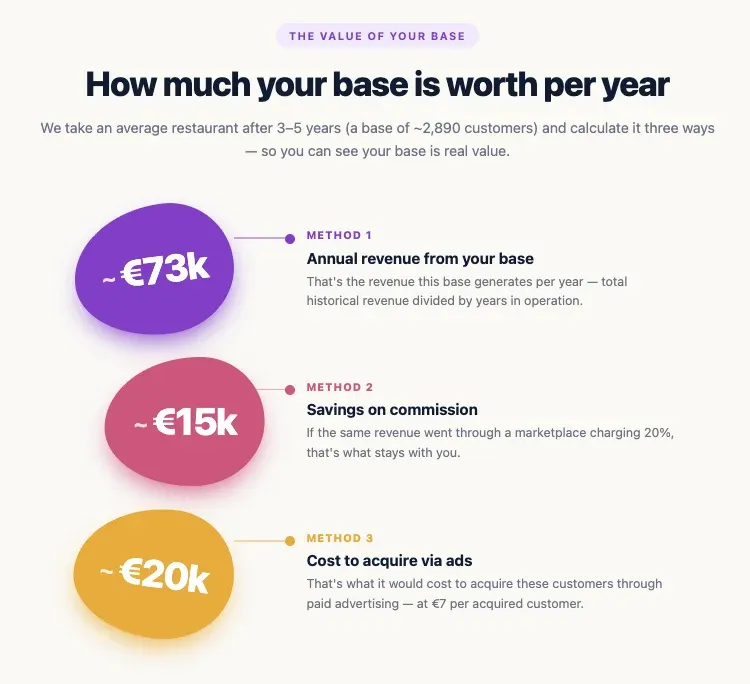
You can change your premises or menu tomorrow. Your customer base stays for years — and it’s worth tens of thousands of euro.
Key takeaways
What this means for your restaurant? There’s one conclusion: build your customer base in a CRM and communicate with it regularly — by SMS, email, in your app, or through a loyalty programme. Here’s why:
How to start? Set up an account and launch sales on your own website and app — UpMenu will automatically start building your base.
One SMS to your base brings in €1,500 to €8,000 in sales, and you send it in three minutes. The cheapest customer is the one you already have.
The CRM module in UpMenu
UpMenu builds your customer base automatically — every order through your website or app feeds it with data and consents collected in line with regulations. And most importantly — this base belongs to you, independent of marketplaces and their commissions.

In practice, the whole system runs itself:
- A customer orders through your website or app and leaves their contact details and consent.
- They land in your base — automatically, with no work on your part.
- Whenever you want, you reach out to them: an SMS with a promotion, a notification about something new, or points for their next order.
- The customer comes back and orders again — and you don’t pay a marketplace a commission for messaging your own customer.
- The longer this wheel turns, the more you earn for the same effort — the base grows, so each new message reaches more people.
On a marketplace you pay twice: once in commission, and once because the customer never becomes yours.
Results (broken down in tables)
How customer value grows per year
A customer’s value depends on how often they order. One loyal customer is worth as much per year as almost fourteen one-time customers.
Customer type | Orders per year | Value per year | How many times more than one-time |
|---|---|---|---|
One-time | 1 | €31 | — |
Returning | 2–4 | €73 | 2.4× |
Regular | 5–9 | €169 | 5.5× |
Loyal | 10+ | €420 | 13.7× |
How we calculated it: these are real figures from over a million customers active in the past year (out of 13 million orders across the full sample), not estimates — for each customer we summed their revenue over the past 12 months and assigned a type based on the number of orders in that period. We validated the values across three consecutive years.
How customer loyalty grows over time
The longer you operate, the more loyal customers you have. Loyal customers make up from 1% of the base (at the start) to 7% (after 5+ years).
Time selling | Ordered once | Returning (2–4×) | Regular (5–9×) | Loyal (10+×) |
|---|---|---|---|---|
less than a year | 594 (74%) | 163 (20%) | 32 (4%) | 10 (1%) |
1–2 years | 933 (66%) | 328 (23%) | 94 (7%) | 53 (4%) |
2–3 years | 1,491 (64%) | 555 (24%) | 168 (7%) | 114 (5%) |
3–5 years | 2,445 (60%) | 1,022 (25%) | 345 (8%) | 291 (7%) |
5+ years | 5,862 (60%) | 2,404 (24%) | 817 (8%) | 759 (8%) |
How the customer and consent base grows
The longer a restaurant sells through its own channel and the larger it is, the bigger the base it builds. And the bigger the base, the greater its value. (Revenue converted to euro.)
Time selling | Brand size | Restaurants studied | Customer base | Direct sales revenue (all-time) | Consent base | % of base with consent | % one-time | % loyal |
|---|---|---|---|---|---|---|---|---|
1–2 years | 1 location | 61 | 1,293 | €98,487 | 541 | 42% | 66% | 4% |
1–2 years | 2–3 locations | 15 | 1,567 | €109,895 | 603 | 38% | 71% | 3% |
1–2 years | 4–9 locations | 5 | 2,332 | €170,653 | 1,102 | 47% | 60% | 4% |
2–3 years | 1 location | 69 | 1,485 | €114,384 | 518 | 35% | 65% | 5% |
2–3 years | 2–3 locations | 18 | 2,840 | €253,379 | 1,113 | 39% | 60% | 6% |
2–3 years | 4–9 locations | 7 | 9,315 | €876,120 | 2,034 | 22% | 61% | 5% |
3–5 years | 1 location | 59 | 2,887 | €297,647 | 951 | 33% | 59% | 7% |
3–5 years | 2–3 locations | 20 | 4,238 | €317,818 | 1,429 | 34% | 63% | 5% |
3–5 years | 4–9 locations | 9 | 6,750 | €727,177 | 2,092 | 31% | 53% | 10% |
3–5 years | 10–39 locations | 4 ⚠ | 15,416 | €1,033,482 | 6,406 | 42% | 63% | 5% |
5+ years | 1 location | 157 | 4,308 | €411,858 | 1,488 | 35% | 60% | 8% |
5+ years | 2–3 locations | 76 | 6,617 | €686,762 | 2,520 | 38% | 59% | 8% |
5+ years | 4–9 locations | 23 | 17,919 | €1,445,812 | 5,782 | 32% | 57% | 8% |
5+ years | 10–39 locations | 18 | 38,895 | €2,381,186 | 13,524 | 35% | 61% | 6% |
5+ years | 40+ locations | 6 ⚠ | 77,412 | €5,746,622 | 35,629 | 46% | 59% | 9% |
⚠ Flagged rows are based on fewer than 5 restaurants — treat them as indicative.
Sixty percent of your customers ordered only once. They haven’t left — they’re just waiting for you to reach out.
How we ran the study (read on if you like details)
- Scope of data analysed. We analysed over 13 million orders from the past 12 years across 1,709 restaurants (595 separate brands) in 18 countries (incl. the USA, eurozone countries, the UK, Canada, Switzerland) — with at least 100 customers who placed an order (our “genuinely operating restaurant” criterion). All amounts were converted to euro at average exchange rates.
- Period studied. The data covers the full online sales history of the restaurants in the sample — from the first order (the oldest accounts are 12 years old) to the time of data extraction. Annual customer values were calculated from the past 12 months and validated across three consecutive yearly windows.
- Date of study. June 2026 (analysis of system data as of 28 June 2026).
- International consistency. Customer behaviour patterns are nearly identical regardless of country: base structure (one-time / returning / regular / loyal) is 62/25/8/5% in Poland and 62/25/8/4% abroad. Consent rates (27% vs 28%) and the share of regular and loyal customers (13% vs 12%) also match. This justifies combining all markets into one sample.
- Averages. All values are arithmetic means for each group. They give a full picture of potential — including both smaller and larger restaurants in each segment. In tables combining all sizes (e.g. loyalty over time), the largest chains inflate the average — which is why the figures for an average single location, the ones most relevant to a typical restaurant, are reported separately under “Key figures”.
- Definitions. “Customer base” means all customers ordering online — in UpMenu every online order automatically creates a record in the base (it does not include phone orders, marketplace orders, or dine-in). Revenue is counted from the full sales history, converted to euro, with outliers trimmed. “Consent base”: customers with active marketing consent (SMS or email).