
A seafood restaurant business plan is a document that defines your concept, market, menu, team, and three-year financials — the roadmap you use to launch and to secure funding.
This guide gives you a complete, filled-in example: Kelphaven Oyster Co., a 60-seat coastal-casual raw bar, with real startup costs, a three-year profit and loss, and a break-even analysis — plus a free template you can copy and adapt.
Key Takeaways
- A seafood restaurant business plan has 8 core sections: executive summary, concept, market analysis, menu & pricing, team, financials, marketing, and appendix.
- The median U.S. restaurant costs: about $375,000 to open — roughly $3,586 per seat — with a median net margin of 5.5%.
- Seafood carries a higher food cost (about 35–40%), so keeping prime cost near 65% and moving orders to a commission-free direct channel protects your margin.
- Demand is structural: Americans ate 19.1 lb of seafood per capita in 2023, while USDA guidelines imply about 26 lb — a lasting demand gap.
Before you start writing, download a free restaurant business plan template with fill-in sections to get started faster.
What a Seafood Restaurant Business Plan Includes
A strong seafood restaurant business plan runs 15–25 pages and covers eight sections:
- Executive summary — a one-page overview written last.
- Company & concept — name, ownership, location, and mission.
- Market analysis — demand, target segments, and competition.
- Menu & pricing — signature dishes, food cost, and price points.
- Team & staffing — roles, headcount, and payroll.
- Financial plan — startup budget, 3-year P&L, and break-even.
- Marketing & technology — how you acquire and keep guests.
- Appendix — licenses, permits, and supporting documents.
The rest of this guide fills in every section with a real example.
- Restaurant Business Plan
- Fast Food Restaurant Business Plan
- Sushi Restaurant Business Plan
- Pizzeria Business Plan
- BBQ Restaurant Business Plan
- Indian Restaurant Business Plan
- Seafood Restaurant Business Plan
- Food Truck Business Plan
- Bar Business Plan
- Catering Business Plan
- Ghost Kitchen Business Plan
- Coffee Shop Business Plan
- Bakery Business Plan
- Ice Cream Shop Business Plan
1. Executive Summary
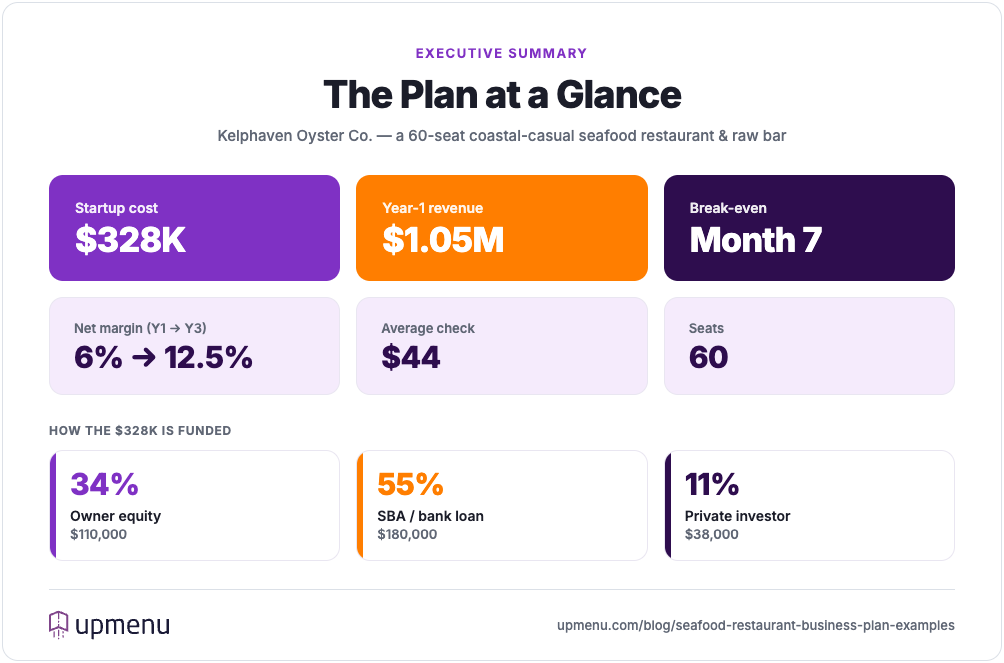
Kelphaven Oyster Co. is a 60-seat coastal-casual seafood restaurant and raw bar opening in a mid-size U.S. coastal city, in a fitted-out second-generation space.
The concept pairs a daily-shucked oyster program with an approachable, sustainably sourced seafood menu at a $44 average check.
The founder is investing $110,000 of equity and seeking $180,000 in SBA/bank financing plus $38,000 from a private investor to cover a total startup cost of $328,000.
The plan projects $1.05M in first-year revenue at a 6% net margin, growing to $1.35M and 9.5% by year three, with break-even reached in month 7.
Write your restaurant executive summary last and keep it to one page.
2. Company & Concept
- Legal name: Kelphaven Oyster Co. LLC (single-member LLC).
- Location: a 2,400 sq ft second-generation restaurant space with an existing hood system, chosen to cut buildout cost.
- Concept: coastal-casual dining plus a raw bar, open for lunch and dinner, with takeout and a small private-events room.
- Mission: to serve the freshest, responsibly sourced seafood at fair prices in a warm, unfussy room.
See our guide to writing a restaurant mission statement.
3. Market Analysis
Demand for seafood is structural. Americans ate 19.1 lb of seafood per capita in 2023, yet USDA dietary guidelines imply roughly 26 lb per year — a persistent gap between what people eat and what’s recommended (NOAA Fisheries). Kelphaven targets three segments:
- Local repeat diners within a 15-minute drive — the core, driving weeknight covers.
- Event and catering clients — higher-ticket seafood platters for celebrations.
- Tourists and passers-by — weekend and seasonal upside.
Competition is mapped with a restaurant SWOT analysis; Kelphaven’s edge is the daily oyster program and a commission-free direct ordering channel that competitors relying on third-party apps don’t control.
4. Menu & Pricing
The menu is built around food cost, not guesswork. Seafood typically runs a 35–40% food cost, so pricing must protect margin.
| Category | Example Items | Price Range | Target Food Cost |
|---|---|---|---|
| Raw bar | Oysters (½ dozen), shrimp cocktail | $16–$22 | 30% |
| Starters | Clam chowder, calamari, crab cakes | $12–$18 | 32% |
| Mains | Grilled fish, seafood pasta, fish & chips | $24–$34 | 38% |
| Signature | Seafood tower (for two) | $68 | 40% |
| Sides & desserts | Fries, slaw, key lime pie | $6–$10 | 25% |
Kelphaven anchors the menu with the oyster program (high margin, high perceived value) and a shareable seafood tower that lifts the average check toward $44.
5. Team & Staffing
| Role | Headcount | Annual Cost (Year 1) |
|---|---|---|
| Owner / GM | 1 | $60,000 |
| Head chef | 1 | $58,000 |
| Line & prep cooks | 4 | $132,000 |
| Servers | 5 | $95,000 (incl. tips base) |
| Raw-bar / shucker | 1 | $38,000 |
| Dishwasher / porter | 2 | $58,000 |
| Bartender | 1 | $34,000 |
| Total payroll | 15 | ~$475,000 |
Payroll and payroll taxes/benefits target about 32% of revenue.
6. Financial Plan
Startup budget — $328,000
| Item | Cost |
|---|---|
| Leasehold improvements (second-gen) | $85,000 |
| Kitchen & raw-bar equipment | $68,000 |
| Furniture, fixtures & décor | $26,000 |
| Initial inventory | $16,000 |
| Licenses & permits (incl. liquor) | $12,000 |
| POS, online ordering & branded app | $6,000 |
| Branding & pre-opening marketing | $14,000 |
| Working capital (3-month reserve) | $78,000 |
| Contingency (10%) | $23,000 |
| Total startup cost | $328,000 |
For context, the median U.S. restaurant opens for about $375,000, or $3,586 per seat; remodeling an existing restaurant space is the cheapest route at a median of $275,500.
Funding
| Source | Amount | Share |
|---|---|---|
| Owner equity | $110,000 | 34% |
| SBA / bank loan | $180,000 | 55% |
| Private investor | $38,000 | 11% |
| Total | $328,000 | 100% |
3-year P&L (projected)
| Line | Year 1 | Year 2 | Year 3 |
|---|---|---|---|
| Revenue | $1,050,000 | $1,208,000 | $1,353,000 |
| Food & beverage cost (36%) | $378,000 | $423,000 | $460,000 |
| Labor (32%) | $336,000 | $374,000 | $406,000 |
| Prime cost | $714,000 | $797,000 | $866,000 |
| Occupancy (8%) | $84,000 | $91,000 | $95,000 |
| Other operating | $189,000 | $205,000 | $223,000 |
| Net profit (pre-tax) | $63,000 | $115,000 | $169,000 |
| Net margin | 6.0% | 9.5% | 12.5% |
The median restaurant nets 5.5%; Kelphaven targets slightly higher by year three because a growing commission-free direct channel avoids third-party fees.
Break-even
With a contribution margin near 41% and monthly fixed costs of about $27,000, Kelphaven breaks even at roughly $66,000 in monthly revenue (about $792,000 per year) — reached in month 7. The median restaurant reaches profitability in about 5 months.
7. Marketing & Technology
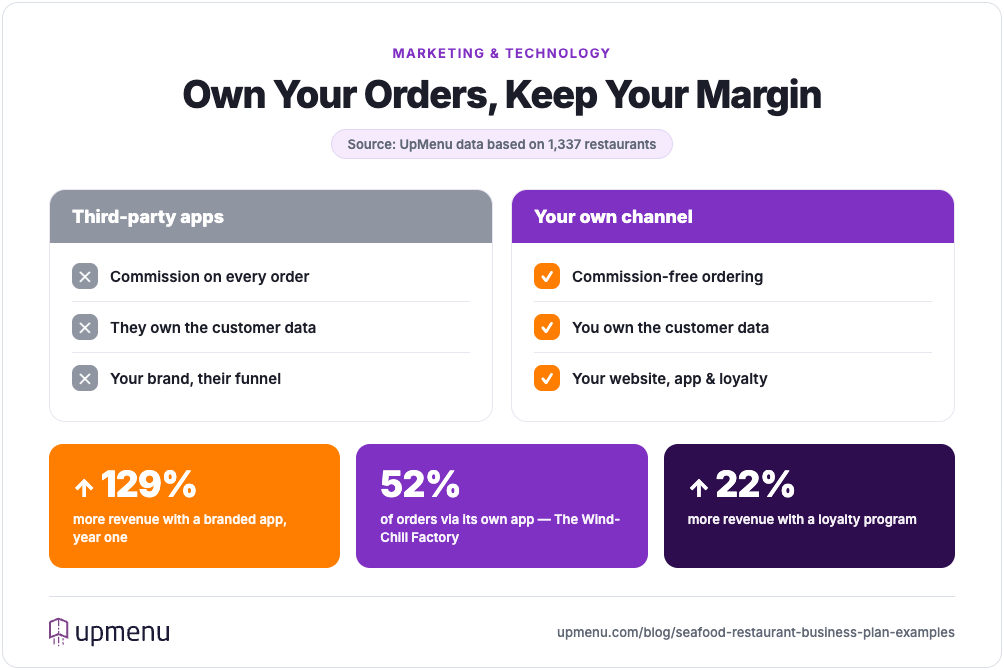
Two levers decide seafood-restaurant margin: filling seats and keeping orders off high-commission third-party apps.
- Local marketing: Google Business Profile, local SEO, and a review program to win the “seafood near me” search. Build these into a full restaurant marketing plan.
- Own the direct channel: a branded website with its own online ordering system and a restaurant mobile app. Across 1,337 restaurants, adding a branded app drove 87% more orders and 129% more revenue in the first year.
- Retention: a loyalty program lifted revenue by an average of 22% across 69 restaurants in the year after launch.
8. Appendix
The appendix holds the supporting documents a lender or investor will ask to see:
- Licenses, permits, and the HACCP plan (see the section below).
- Signed or draft supplier agreements and sample seafood sourcing certifications.
- The lease or letter of intent for the space.
- Founder resume and any key-hire bios.
- Detailed financial schedules — full cash-flow forecast and equipment quotes behind the summary tables above.
Keep it to what backs up the plan; don’t pad it.
Licenses & Permits for a Seafood Restaurant
Requirements vary by state and city, but most seafood restaurants need:
- A business license and Employer Identification Number (EIN).
- A food service / health department permit and a food handler’s certification.
- A HACCP plan — often required for seafood handling and storage.
- Seafood-specific sourcing and labeling compliance (FDA guidance).
- A liquor license, if you serve alcohol.
- A certificate of occupancy and fire inspection for your space.
Confirm exact requirements with your local health department before signing a lease.

Frequently Asked Questions (FAQ)
How much does it cost to open a seafood restaurant?
The median U.S. restaurant opens for about $375,000, or roughly $3,586 per seat (RestaurantOwner.com). Our Kelphaven example totals $328,000 by using a fitted-out second-generation space.
Is a seafood restaurant profitable?
Yes, when run tightly. The median restaurant nets 5.5%. Seafood has a higher food cost (about 35–40%), so keep prime cost near 65% and shift orders to a commission-free direct channel to protect margin.
What net profit margin is realistic for seafood?
About 4–8% after the first year once operations stabilize; a commission-free ordering channel helps push it higher.
Do I need financial projections to get funding?
Most single-location shops make $200,000 to $500,000 a year. Premium shops with catering, delivery, and branded merchandise can pass $1 million.
