Starting a catering business can be lucrative, but it requires a well-structured business plan.
This article will guide you through the process of creating a tailored catering business plan, covering key elements such as concept development, market analysis, and financial planning.
We’ll also provide examples and templates to help you craft a restaurant business plan for your new or existing catering business.
What is a Catering Business Plan?
A catering business plan is a comprehensive document that outlines the intended activities, objectives, and strategies for a new or existing catering business.
It serves as a roadmap for effectively establishing and operating a catering business.
How to Write a Catering Business Plan
Create your catering business plan using a pre-designed template encompassing the essential sections. Ensure that your plan includes the following key components:
- Executive Summary of a Restaurant: Provide an overview of your catering business and its objectives.
- Business Description: Describe your catering services, target market, and competitive advantages.
- Market Analysis: Conduct a thorough analysis of the catering industry, including market trends, customer preferences, and competitor analysis.
- Marketing and Sales Strategy: Outline your marketing and sales initiatives to attract catering clients and promote your catering services.
- Operations Plan: Detail the operational aspects of your business, including location, equipment, staffing, and logistics.
- Financial Plan: Present your financial projections, including startup costs, revenue forecasts, and profitability analysis.
- Management and Organization: Describe the structure of your catering business, key team members, and their roles.
- Risk Assessment: Identify potential risks and challenges affecting your catering business and propose mitigation strategies.
Step 1: Executive Summary
The executive summary provides an overview of your catering business plan, covering:
- Mission, Vision, and Values: State the guiding principles behind your restaurant.
- Catering Concept and USP: Highlight your unique idea and differentiators.
- Success Factors: Explain why your concept is poised for success.
- Implementation Plan: Outline key steps to launch your restaurant.
- Financial Overview: Discuss projected costs, profits, and ROI.
Step 2: Description of the Catering Company
In this section, provide a concise yet informative overview of your new catering business, highlighting its essential elements:
- Restaurant mission statement: Clearly state the purpose and goals of your restaurant.
- Structure: Specify the legal structure and organizational setup of your business.
- Restaurant concept: Define the type of restaurant, including its name, style, and ambiance.
- Location: Describe the chosen or potential location, emphasizing its advantages.
- Menu: Outline the cuisine type and showcase sample menu items.
- Unique Selling Points (USPs): Highlight the distinctive features that set your restaurant apart.
Step 3: Market Research and Competition Analysis
Market Overview
Thoroughly research the restaurant industry and your target market to gain a comprehensive understanding. Focus on the following aspects:
- Target Group: Define your ideal customer profile based on age, interests, preferences, and dining habits.
- Market Needs: Identify the specific needs and demands in the market that your restaurant aims to fulfill.
- Target Audience Size: Estimate the potential customer base within your geographic area to gauge market size and growth opportunities.
- Market Trends: Stay updated on the latest food trends, changing consumer preferences, and technological advancements.
Competition Analysis
Thoroughly analyze your competition to gain insights into their strengths, weaknesses, and strategies. Consider the following:
- List of Competitors: Identify direct and indirect competitors in your area, categorizing them based on cuisine, target market, pricing, and positioning.
- Revenue and Order Volume: Estimate the revenue potential and order volume of competing restaurants to gauge their market share and profitability.
- Menu and Pricing: Evaluate competitors’ menus and strategies, considering variety, ingredient quality, portion sizes, and pricing structures. Assess their food costs to understand profitability.
- Competitor Marketing Activities: Study competitors’ marketing efforts, including branding, online presence, advertising, and customer engagement.
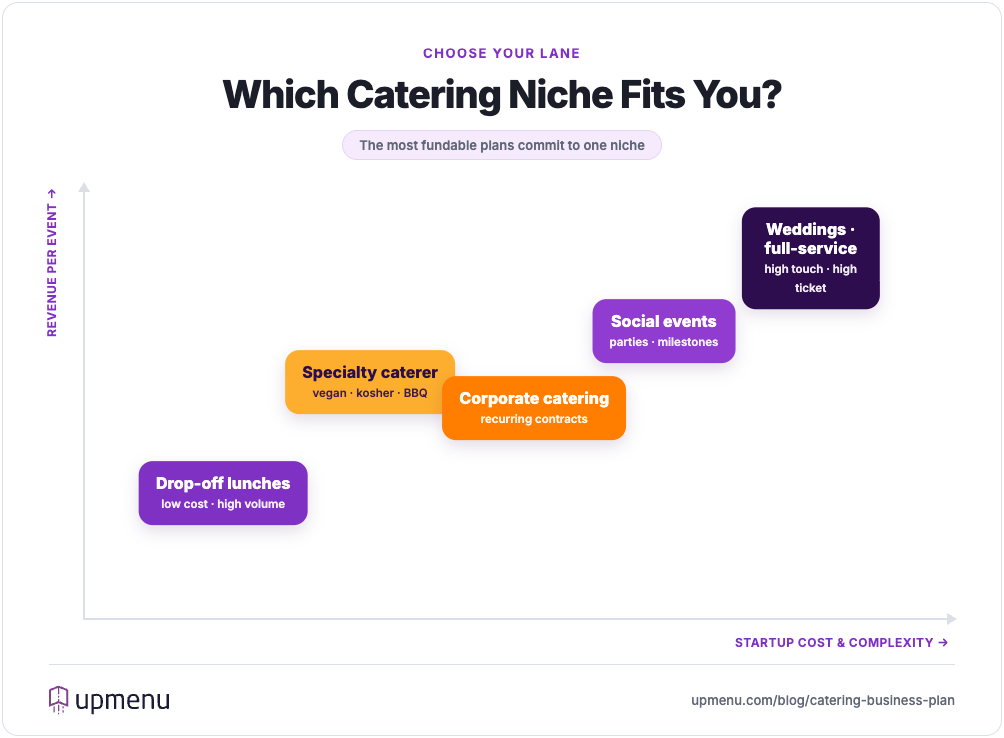
- Competitive Advantages: Emphasize the unique advantages of creating a successful catering business, such as innovative menu offerings, superior service, ambiance, location advantage, sustainability practices, corporate events, or a specific culinary niche.
Step 4: SWOT Analysis
Conduct a restaurant SWOT analysis to comprehensively understand your restaurant’s internal strengths and weaknesses, as well as external opportunities and threats.
Here is an example of a restaurant SWOT analysis:
Strengths:
- Talented and experienced chef
- Exceptional customer service
- Strong brand proposition and unique selling points
Weaknesses:
- Limited capital for initial investment
- Inexperienced team members in certain areas
- Operational inefficiencies that require improvement
Opportunities:
- Emerging food trends that align with your restaurant concept
- Growing market demand for your cuisine type
- Potential strategic partnerships for increased exposure and collaboration
Threats:
- Intense competition from established restaurants in the area
- Economic fluctuations that may affect customer spending habits
- Regulatory changes impacting the restaurant industry
Step 5: Investment Plan (Cost Analysis)
In this section, you will outline the costs associated with the initial investment and the spending plan for the first year of operation.
These costs can be divided into two main groups: investment and operating costs.
Investment Costs (One-off to Start)
- Real Estate: Include expenses for securing a suitable location through rental or purchase.
- Premises Renovation: Account for costs related to construction, plumbing, electrical work, and interior design.
- Kitchen Equipment: List essential equipment such as ovens, stoves, refrigerators, dishwashers, and utensils for food preparation.
- Dining Area Furnishings: Include costs for tables, chairs, decorations, lighting fixtures, and staff uniforms.
- IT Software and Hardware: Account for POS software, payment terminals, and computer hardware expenses.
- Marketing and Promotion: Include costs for logo design, website development, menu printing, and promotional materials.
- Insurance: Calculate expenses for insuring the premises and equipment.
- Organizational and Legal: Account for permits, licenses, and legal documentation costs.
- Training: Include expenses for staff training and certification programs.
Operating Costs (Fixed Monthly Costs)
- Real Estate Rental: If applicable, include monthly rental payments.
- Utilities: Account for recurring costs like electricity, gas, and water bills.
- Staff Wages: Calculate wages or salaries for restaurant staff.
- Food and Beverage Costs: Estimate ongoing expenses for ingredients and supplies.
- Equipment Maintenance: Include costs for regular equipment servicing and maintenance.
- Service Charges: Account for charges related to cleaning services, POS system support, and online ordering fees.
- Employee Insurance: Calculate costs for insurance coverage for employees.
- Marketing and Promotion: Allocate a restaurant budget for ongoing marketing activities.
- Taxes and Fees: Include estimated tax obligations and other applicable fees or licenses.
Remember to regularly review and update these costs to ensure accuracy and monitor financial performance.
Step 6: Financial Forecast
The financial plan for your restaurant consists of three key elements: the projected restaurant profit and loss statement (P&L), break-even analysis, and sensitivity analysis. Here’s an overview of each element:
Profit and Loss Statement (P&L)
- Estimate your expected revenue based on restaurant size, target market, sales volume, and pricing strategy.
- Calculate the cost of goods sold (COGS) by considering ingredients, raw materials, and beverages required for your menu items.
- Deduct COGS from revenue to determine the gross profit, which covers operating expenses.
- Include fixed and variable operating expenses such as rent, utilities, wages, marketing, and insurance.
- Calculate the net profit or loss by subtracting total operating expenses from the gross profit.
Break-even Analysis
- Identify fixed costs that remain constant regardless of sales volumes, such as rent, utilities, and insurance.
- Determine variable costs for each unit sold, including ingredients and direct labor costs.
- Calculate the contribution margin, which represents the revenue remaining after subtracting variable costs from sales.
- Divide total fixed costs by the contribution margin to determine the break-even point, indicating the number of units (meals or drinks) needed to cover expenses.
Sensitivity Analysis
- Conduct a sensitivity analysis to assess the impact of negative scenarios on your restaurant’s turnover and profit.
- Adjust critical variables, such as sales volume or pricing, to evaluate the potential effects on financials.
- Consider scenarios like a 50% decrease in turnover for a specific period and analyze the resulting impact on profitability.
By utilizing these elements, you can evaluate your restaurant’s financial feasibility and profitability.
Regularly review and update your economic forecasts to track performance, make informed decisions, and build a successful catering business.
Step 7: Catering Team
Founders
The management team plays a key role in shaping the restaurant’s vision and success. This section is crucial for attracting investors or partners:
- Founders: List the names and roles of each founder.
- Experience: Highlight relevant industry experience, skills, and notable achievements that contribute to the restaurant’s success.
Employees
Your employees are essential for smooth operations. Include the following details:
- Job Titles: List required positions (e.g., chefs, waitstaff).
- Duties: Describe responsibilities for each role.
- Remuneration: Specify compensation details, such as wages and benefits.
- Contract Type: Indicate full-time, part-time, or seasonal contracts.
By outlining the founders’ experience and your employees’ roles and responsibilities, you showcase a capable and dedicated team that will contribute to your restaurant’s success.
Step 8: Catering Marketing Plan
Your restaurant marketing plan should encompass a range of marketing strategies to promote your restaurant and attract customers.
Key components of your plan should include:
- Brand Building: Establish a recognizable brand identity through a logo, colors, and a catchy slogan.
- Online Presence: Create a professional catering website to showcase your catering concept and menu.
- Online Ordering: Integrate direct ordering into your website’s catering software, and consider partnering with external food delivery platforms.
- Innovative Customer Experience: Explore options such as tableside ordering and a loyalty program to enhance the dining experience and encourage customer retention.
- Offline Customer Acquisition: Utilize flyers, local radio advertising, public relations, and events to attract customers in your area.
- Online Customer Acquisition: Use social media, SEO, Google Maps listing, email, SMS campaigns, blogging, and targeted paid advertising to reach and engage customers online.
- Promotions: Offer special promotions and discounts to entice customers, and regularly evaluate their effectiveness.
- Competition Edge: Identify and emphasize your competitive advantage.
A well-rounded marketing plan can effectively promote your restaurant, build a solid customer base, and drive business growth.
Continuously evaluate customer feedback and monitor market trends to make informed adjustments to your marketing strategies for optimal results.
Key Points to Create a Catering Business Plan
- Be concise and specific when writing your plan.
- Utilize numbers for accurate calculations and financial projections.
- Consider worst-case scenarios and incorporate contingency plans.
- Review and update your plan regularly, particularly in the early stages of your business.
- Engage your team in discussing the business plan and consider profit-sharing initiatives to foster commitment.
- Recognize that a business plan is a multi-year document that should be updated periodically.
Why Writing a Business Plan Matters
A catering business plan is essential for building and running a successful business. Here’s why:
- Turning Ideas into Action: It transforms your concept into a structured plan.
- Strategic Focus: It shifts focus from daily operations to long-term strategy.
- Validating Assumptions: It helps track progress and refine projections.
- Translating Vision into Action: It provides a clear roadmap with specific goals.
- Evaluating Viability: It assesses your idea’s feasibility and identifies challenges.
- Risk Assessment: It helps identify risks and develop contingency plans.
- Encouraging Specificity: It forces you to address key questions and gaps.
- Improving Operations: It guides assessment and growth for established businesses.
Key Takeaways
Describe Your Catering Business: Provide a detailed description of your catering business, including its concept, target market, menu, ambiance, and unique selling points.
Elements of a Business Plan: Ensure your business plan includes all essential sections, such as an executive summary, restaurant description, financial forecasts, and marketing strategies.
Continuous Planning: Whether you’re opening a restaurant or refining an existing one, regularly review and update your business plan to stay responsive to market changes, and customer preferences.
Seek Expert Advice: Don’t hesitate to consult a restaurant consultant for expert guidance. Their experience can help refine your ideas and ensure your business plan is thorough and well-informed.
Regular Review: Review your business plan regularly, with monthly check-ins in the early stages and an annual review as your catering business grows.