
Talk to sales Contact Login English

BBQ Business Plan (Free Template + Example)

Contents

A BBQ business plan is a written roadmap for a barbecue restaurant that covers your concept, target market, startup costs, and financial projections — it’s what turns “I make great brisket” into a fundable business.

The U.S. barbecue-restaurant market is worth about $4.9 billion across roughly 15,450 businesses, and it’s so fragmented that no single chain holds even a 5% share.

There’s room for a sharp concept, but margins are thin, so your plan is what wins the lease, the loan, and the first year.

Throughout this guide I’ll build one example alongside the instructions — Ashline Smokehouse, a fast-casual Texas-style BBQ spot — so you can see what a finished section looks like, not just what it should contain.

Key Takeaways

  • A BBQ business plan needs eight parts: executive summary, concept & menu, market & competition, SWOT, team & operations, marketing, startup costs, and financial projections.
  • Opening a barbecue restaurant typically costs: $175,000–$500,000+; the U.S. median for an independent restaurant is about $375,000 ($113 per sq ft).
  • BBQ runs on thin margins: the industry median net profit is about 5.5% — so keep food cost near 30–33% and protect it from delivery-app commissions.
  • Differentiate on a regional style: Texas, Kansas City, Carolina, Memphis, and a few signature cuts done exceptionally well, not a giant menu.
  • Own your ordering: restaurants that push customers to their own website and branded app avoid 15–30% third-party fees.

Use our free BBQ restaurant business plan template as a starting point, then tailor each section to your concept, target market, operations, and financial projections.

Get a free business plan template

1. Executive Summary

The executive summary is the first thing a lender or investor reads, so I write it last and keep it to one page.

It should state your concept in a sentence, name your target market, say how much money you need and how you’ll use it, and end with your single biggest competitive edge.

Write down your executive summary for restaurant after the rest of the plan is done — that’s when you actually know your numbers — and lead with a sharp restaurant mission statement that captures why the place exists.

Example — Ashline Smokehouse, executive summary (excerpt):

Ashline Smokehouse is a fast-casual, counter-service barbecue restaurant serving Central-Texas-style brisket, ribs, and pulled pork from a 1,800 sq ft second-generation space in suburban Austin.

We’re seeking $285,000 in startup capital ($120,000 owner equity, $165,000 SBA-backed loan) to open, hire a six-person team, and reach break-even within the first year.

Our edge: a tight, high-quality menu, commission-free online ordering through our own website and branded app, and a catering arm targeting local offices and events.

2. BBQ Restaurant Concept & Menu

Pick a regional style — it’s your identity. It focuses your smoker, menu, and brand:

  • Texas — beef-forward; brisket, beef ribs, sausage; salt-and-pepper rub, sauce on the side.
  • Kansas City — ribs and burnt ends; thick, sweet, tomato-molasses sauce.
  • Carolina — pulled pork; vinegar (Eastern NC) or mustard (SC) sauce.
  • Memphis — dry-rub ribs; sauce optional.
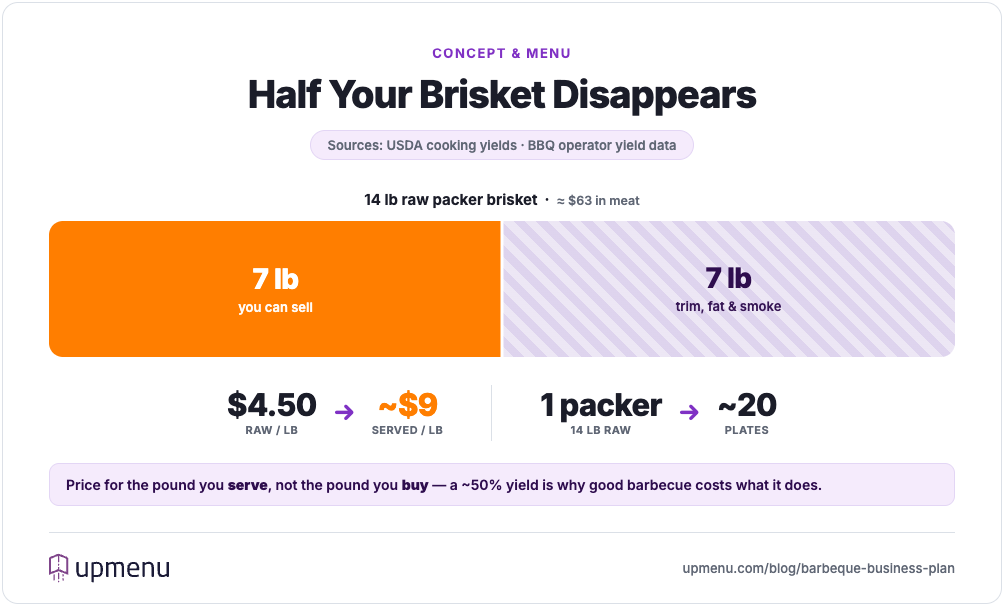
Diagram showing a 14 lb raw brisket yields about 7 lb served (~50%) after trim and smoking, and why menu pricing must reflect it

Keep the menu small: A few cuts done exceptionally well beat a sprawling menu — and a smoke cycle runs 12–16 hours, so tomorrow’s brisket count is capped tonight; plan capacity around the cook cycle.

Then cover the rest: business structure, location, restaurant type (dine-in, fast-casual, or a food truck), and the dining experience.

Example — Ashline Smokehouse menu: Sliced brisket, pork ribs, pulled pork, and smoked turkey (a leaner option), plus four sides, a house coffee-chili rub, and a build-your-own-plate format for fast throughput. A BBQ menu template speeds up pricing and layout.

3. Market & Competition

The U.S. barbecue-restaurant industry spans roughly 15,450 businesses and is highly fragmented — no operator holds even a 5% share, which lowers the barrier for a strong independent.

Demand has a tailwind: household grill or smoker ownership rose from 64% in 2019 to 80% in 2023. Note the expanding chains (Dickey’s, Mission BBQ) as indirect competition.
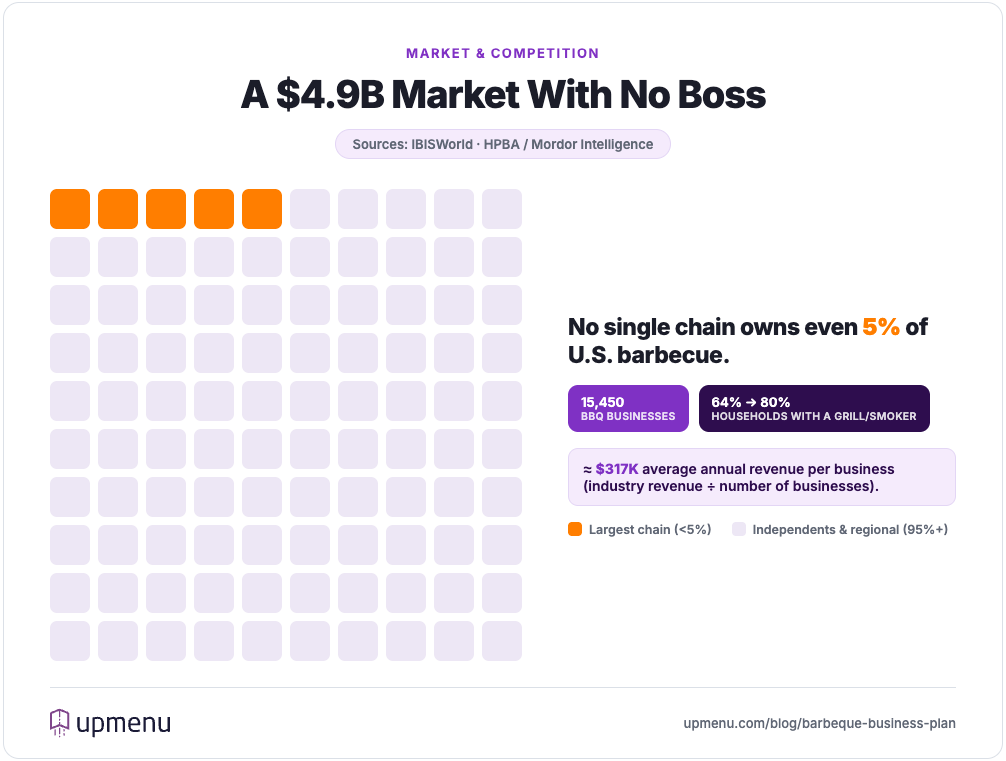
Waffle chart showing no U.S. barbecue chain holds even 5% market share

List three to five real competitors within your radius and score each on style, price, and the gap you’ll fill, then sharpen positioning with a SWOT analysis for a restaurant.

Competitor Style Price Point Weakness / Our Opening
Direct A (established smokehouse) Texas, full-service $$$ Slow service; we win on fast-casual speed
Direct B (BBQ food truck) Kansas City $$ No dine-in and no online ordering; we own the direct digital channel
Indirect C (burger fast-casual) $$ No BBQ credibility; we own the category locally

4. SWOT Analysis

Do your SWOT as a table, not a paragraph. Here’s an example of Ashline Smokehouse:

Strengths Weaknesses
Signature Central-Texas brisket and house rub; fast-casual speed with lower labor than full-service; commission-free direct ordering via our own app; low buildout in a second-generation space High protein COGS and brisket shrink; the smoke cycle caps daily capacity; single-cuisine concentration; a new brand with no loyalty base yet
Opportunities Threats
High-margin catering and events; regional-style differentiation; leaner and plant-based options to widen the audience; a grilling tailwind (80% of households own a grill or smoker) Fragmented but crowded field (~15,450 BBQ restaurants); protein-price volatility; chain expansion (Dickey's, Mission BBQ); 15–30% third-party delivery commissions

5. Team & Operations

Investors bet on people. Introduce your founders and their relevant experience, then map key roles with realistic pay (budget labor at ~25% of sales).

Example roles & pay: a pitmaster/head cook (the make-or-break hire), two line cooks, three counter/service staff, and a part-time manager. Operational reality: a smoke cycle runs 12–16 hours, so your pitmaster’s overnight schedule and next-day brisket count are fixed — build the roster around them.

6. BBQ Restaurant Marketing Plan

Own your orders — it’s the single biggest margin lever in BBQ. Third-party delivery apps charge roughly 15–30% per order, which is brutal on a 5% net margin.

Restaurants that push customers to their own website and branded app keep that money. Real numbers from UpMenu clients:

  • Michelangelo 301 drove 51% of online orders through its own branded app and saved about $130,000 in commissions in a single year (versus an average 15% third-party fee).
  • Yami Sushi generated €107,684 in under a year of online sales, with 38% of orders coming through its branded app.
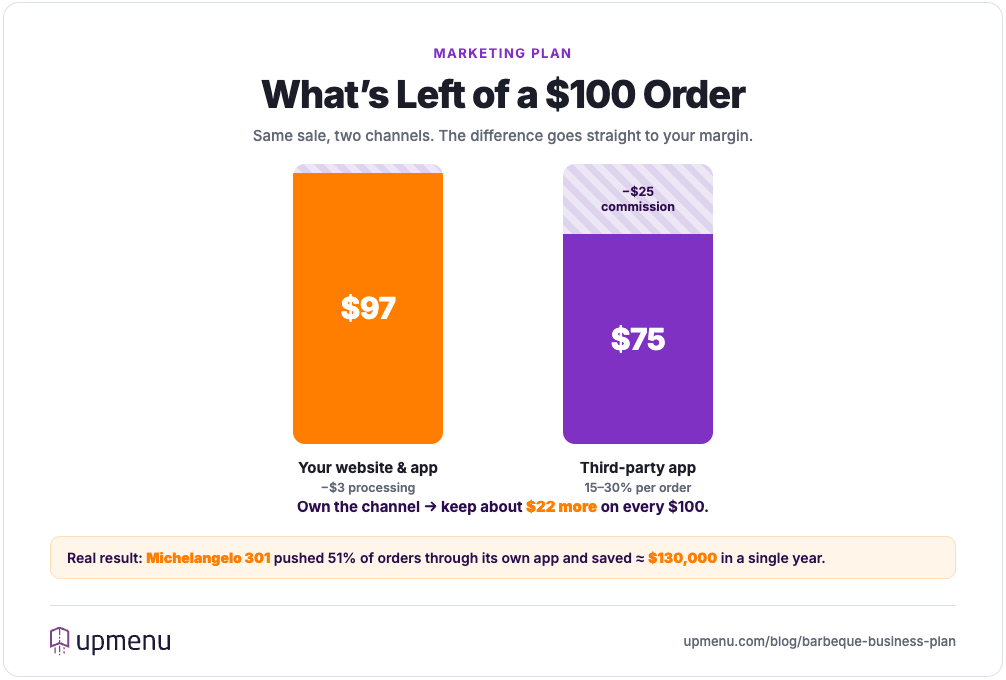
What a restaurant keeps from a $100 order: own app $97 vs third-party app $75

Build the rest around that: a professional website with an integrated menu (a BBQ website template gets you live fast), commission-free online ordering, a branded restaurant mobile app, loyalty, and local SEO.

7. Startup Costs

Opening a barbecue restaurant typically costs $175,000–$500,000+.

The U.S. median for an independent restaurant is about $375,000 ($113 per square foot); taking over a second-generation space (one with an existing hood and grease trap) can cut buildout by $30,000–$80,000.

Here’s a lean fast-casual build for the example concept.

Startup Cost Line Ashline Smokehouse (example)
Lease deposit + first months' rent $12,000
Buildout / renovation (second-generation) $70,000
Smoker + grills $28,000
Refrigeration (walk-in + reach-ins) $18,000
Kitchen smallwares & prep $12,000
Furniture, 48 seats, décor $22,000
POS + online ordering + branded app + KDS $9,000
Signage & branding $8,000
Initial inventory (meat, wood, sauces, packaging) $14,000
Licenses, permits, health, insurance (year 1) $16,000
Pre-opening marketing & website $10,000
Hiring & training $8,000
Working capital reserve (3 months) $58,000
Total $285,000

Always add a 10–20% contingency. For Ashline that’s about $43,000, so we’d actually raise roughly $328,000.

8. Financial Projections

Build your financials bottom-up: revenue first, then a monthly profit-and-loss, then break-even.

Revenue (bottom-up): Average ticket $24 × 130 covers/day × 28 days = ~$87,000/month (~$1.05M/year) — in line with the industry median of about $1.1M in annual sales.

Monthly profit & loss (steady state):

Line Monthly % of Sales
Revenue $87,000 100%
Food cost (COGS incl. wood/packaging) $27,900 32%
Labor $22,000 25%
Rent $4,200 5%
Utilities $2,400 3%
Marketing $3,500 4%
Payment processing $2,600 3%
Software, insurance, maintenance, admin $2,650 3%
Operating profit (pre-debt/tax/owner) ~$21,750 ~25%

After loan service, owner compensation, depreciation, and taxes, expect a net margin around the industry median of ~5.5%, with most independents reaching profitability in about 5 months. For a fuller model, work from a restaurant’s profit and loss statement.

Break-even: fixed monthly costs ÷ contribution-margin ratio.

With about $31,000 in fixed costs and a 61% contribution margin, break-even is roughly $51,000 in monthly sales — about 76 covers a day.

Ashline example projects 130, comfortably above. Finish with a sensitivity check — model a 20% traffic drop or a 10% protein-cost jump so you know your cushion before signing a lease.

Common BBQ Business Plan Mistakes

  1. Underestimating protein COGS and shrink: Brisket loses ~30–40% of its raw weight in the smoker — plan food cost at 30–33% of sales.
  2. Building the menu too big: A few cuts done perfectly beat 30 mediocre items and a blown-up prep line.
  3. Ignoring smoke-cycle capacity: You can’t sell more brisket tonight — it was decided 14 hours ago; model capacity around the cook cycle.
  4. Leaning on third-party delivery: At 15–30% commission, apps can erase a 5% net margin; make direct ordering the default.
  5. No contingency or working capital: Add a 10–20% buffer and three months of fixed costs — most first-timers run out of runway, not ideas.
  6. Skipping break-even math before signing a lease: Know your covers-per-day number first, then let it set the rent you can afford.

Frequently Asked Questions (FAQ)

Typically $175,000–$500,000+. The U.S. median for an independent restaurant is about $375,000 ($113 per sq ft); a lean fast-casual BBQ spot in a second-generation space can open for roughly $285,000 plus a 10–20% contingency.

They can be, but on thin margins — the industry median net profit is about 5.5%. Profit depends on controlling protein cost (30–33% of sales) and avoiding high delivery-app commissions.

A single fast-casual location averaging a $24 ticket and about 130 covers a day generates roughly $1M+ in annual sales, close to the ~$1.1M industry median in annual revenue.

A business license, food service license, health department permits, fire permits, food-handler certification, and a liquor license if you serve alcohol. Start early — liquor licenses can take months.

Picture of Dominik Bartoszek

Dominik Bartoszek

Marketing Manager at UpMenu. Leads UpMenu's marketing and helps restaurants grow. Writes about restaurant marketing, branding, websites, menu design, and opening a restaurant — from pizzerias and food trucks to coffee shops and ghost kitchens. Digital marketer driven by data and AI — for 6+ years working with restaurants.

More from UpMenu:

Try for free,
no commitment!