
Talk to sales Contact Login English

Sushi Restaurant Business Plan: Free Sample & Template (2026)

Contents

A sushi restaurant business plan is a written document that outlines your concept, target market, menu, marketing, operations and financial projections for a sushi bar or restaurant.

It usually covers 7 core sections — executive summary, business structure, products, market analysis, marketing, pricing, and budget.

Below is a complete, filled-in sample you can copy and adapt for your own sushi restaurant.

Key Takeaways

  • Startup cost: opening a small full-service sushi restaurant typically runs $275,000–$425,000 (about $3,046 per seat, leased); lean quick-service or ghost-kitchen concepts can start at $80,000–$150,000.
  • The market is large and open: the U.S. sushi-restaurant industry is worth about $33.2 billion across ~17,300 businesses, growing ~2.4% a year and highly fragmented — no company holds more than about 5% share, leaving room for new entrants (IBISWorld, 2025).
  • Margins are thin: restaurant net profit averages 3–9%, so keep prime cost (food + labor) at or below 60–65% of sales.
  • Plan for off-premise from day one: delivery and pickup are a large share of sushi orders, so build in a commission-free online ordering system rather than relying on third-party apps.

Sushi Restaurant Business Plan Template

Don’t start from a blank page. Grab our free restaurant business plan template for the core structure that works for any food business, then use this guide to layer in everything specific to sushi — your fish sourcing, your menu, your delivery economics, and the margins we’ll get to below.

Get a free business plan template

To make it concrete, I’ve filled in every section for a fictional example — Midtown Sushi Co., a small full-service sushi bar built around office-lunch trade and delivery near Bryant Park in New York City.

You’ll see its numbers threaded through each section as we go.

1. Executive Summary

The executive summary is the one page that decides whether anyone reads the other twenty.

Write it last, but place it first. It’s a tight overview of the whole plan: your concept, why it’ll work, what it costs, and what you’re asking for. (For the mechanics of the section itself, see our guide to the executive summary for a restaurant.)

Example:

Midtown Sushi Co. is a small full-service sushi bar opening near Bryant Park in Midtown Manhattan, an area dense with offices and tourists but short on fast, high-quality sushi. We compete on fresh, chef-made sushi and quick, commission-free delivery and pickup ordered directly through our own website and app.

Opening requires $275,000, of which the founders contribute $140,000 and seek $135,000 in SBA-backed financing. We project $550,000 in first-year sales at a 5% net margin, reaching break-even within month ten.

2. Concept & Menu

This is where a sushi plan earns its keep. Your menu and your fish sourcing dictate your equipment, your staffing, and your margins — so commit to them here, then build the rest of the plan around them.
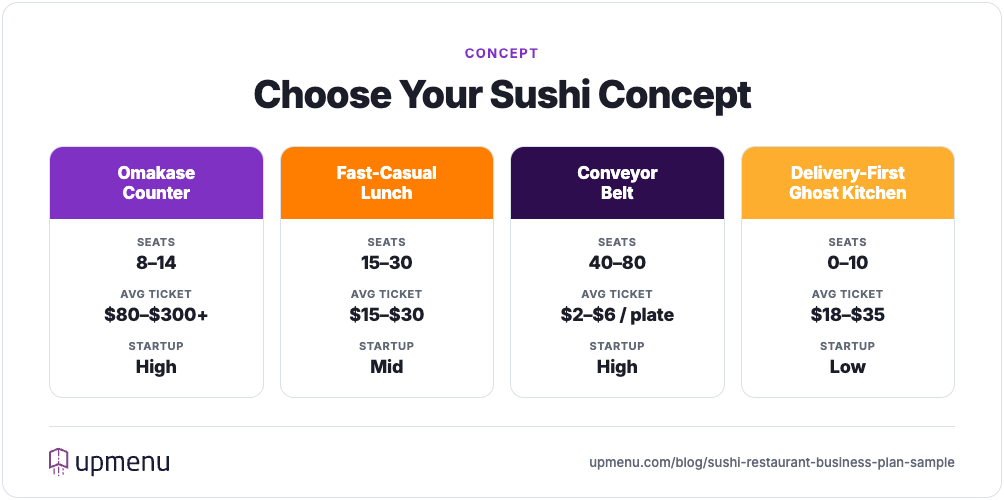
Comparison of four sushi restaurant concepts — omakase counter, fast-casual lunch, conveyor belt and delivery-first — by seats, average ticket and startup cost

Spell out:

  • Menu & sushi style: what you actually serve and what makes it yours. (Example: nigiri, maki and sashimi, plus five signature rolls and a short hot-dish and drinks list.)
  • Service model: dine-in, takeout, delivery — and which one leads. (Example: lunch-led takeout and delivery first, a small 20-seat dine-in second.)
  • Fish sourcing & food safety: your supplier plan, freshness standards and cold chain — the thing that makes or breaks a sushi bar. (Example: daily sushi-grade deliveries from a vetted seafood supplier, dedicated cold storage, HACCP-based handling.)
  • Operations & hours: how an order flows from order to counter to customer, your hours, and whether delivery is in-house or third-party. (Example: in-house delivery within 2 miles, open 11am–9pm.)
  • Legal structure & ownership: LLC, partnership or corporation, and who owns what.
  • Mission & concept: what makes you the obvious lunch choice on your block. Anchor it to a clear restaurant’s mission statement.

The reason this section comes early: an omakase counter needs a master itamae and premium fish at 40%+ food cost, while a high-volume lunch shop leans on prepped rolls and speed. 

Lock the concept, and the cost, staffing and equipment decisions later in the plan write themselves.

3. Market & Competition

Lenders want proof there’s room — and appetite — for your sushi bar. The national picture is on your side.

Then zoom in to your block:

  • Target customer: age, income, and how they prefer to order. (Example: office workers and tourists within a few blocks of Bryant Park, ordering lunch for pickup or fast delivery.)
  • Direct & indirect competitors: name them, note their price, speed and weak spots. (Example: several Midtown sushi bars with slow delivery, plus grab-and-go chains with lower-quality rolls.)
  • Your opening: the gap you fill. (Example: the only fast, quality, app-ordered sushi with real lunch specials in the immediate area.)

4. SWOT Analysis

A one-glance grid of where you’re strong and where you’re exposed — lenders scan it in seconds. Build it as a simple table. (For the full method, see our SWOT analysis for restaurants.)

Here’s an example:

Strengths Weaknesses
Experienced sushi chef; prime Bryant Park foot traffic; commission-free direct ordering Limited seating; high premium-fish cost exposure; low early brand recognition
Opportunities Threats
Growing demand for healthy, protein-rich dining; office lunch specials; delivery and pickup Many competing Midtown sushi bars; fish-price volatility; thin restaurant margins

5. Team

A sushi bar’s plan lives or dies on one hire: the sushi chef (itamae). List your roles, who fills them, and what they cost.

  • Founders: names, experience, and why you’re the right people to run this.
  • Key hire — the sushi chef: someone who can run the counter and hold quality and food-safety standards. If you can’t train the line yourself, budget for a consultant in your startup costs.
  • Supporting roles: prep cooks, cashiers, delivery drivers (in-house or third-party), and a manager — you, at first. See typical restaurant staffing roles and pay ranges.

Before you open, line up the required permits — a business license, food-service and food-handler permits, health-department approval, seafood-handling compliance, and, if you serve beer or sake, a liquor license.

Exact requirements vary by state and city.

6. Marketing

Sushi is a repeat-purchase, lunch-driven business, so your marketing plan should win the first order and then earn the next one.
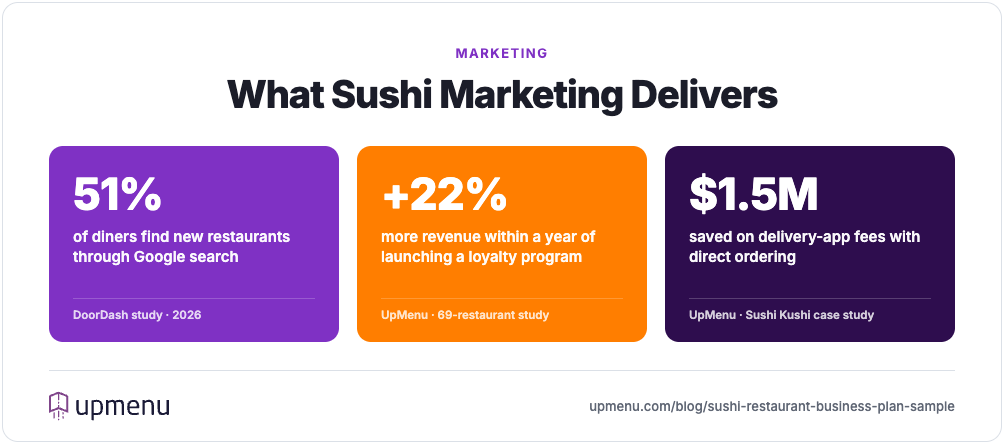
Sushi restaurant marketing stats: Google discovery 51%, loyalty +22% revenue, and $1.5M saved on delivery fees with direct ordering

Get found on Google, turn first-timers into regulars, and protect your margin by owning your ordering channel — the Sushi Kushi chain saved $1.5M in delivery-app fees doing exactly that.

  1. Launch: a grand opening, local social ads targeted at nearby workers, and leaflets in the surrounding offices.
  2. Get found: claim and optimize your Google Business Profile and Yelp listing — most lunch searches start there.
  3. Own the repeat order: drive customers to your own online ordering system so you keep the commission third-party apps take, and reward regulars with a restaurant loyalty program. (Example: a “Lunch Special” and a points-based loyalty offer for weekday regulars.)

For a deeper playbook, see our restaurant marketing strategies and our guide to increasing restaurant sales.

7. Startup Costs

This is the section lenders check hardest, so make it a line-by-line budget — not a single guessed number.

As a benchmark, most independent full-service restaurants in the U.S. cost $275,000–$425,000 to launch — roughly $3,046 per seat for a leased space (RestaurantOwner.com survey of 350+ owners).

Quick-service or ghost-kitchen sushi concepts can start far lower ($80,000–$150,000). If you want to start lean, our food truck business plan shows a lower-cost path into the market.

Here’s the filled-in budget for Midtown Sushi Co.:

Startup Cost Category Sample Budget (Small Full-Service Sushi Bar) Typical Range
Lease deposit + first months' rent $30,000 $20–60 / sq ft / year
Kitchen equipment (incl. refrigeration, sushi prep) $70,000 $50,000–$150,000
Furniture, décor & fit-out $35,000 $10,000–$50,000+
Licenses & permits (food, seafood handling, liquor) $20,000 $10,000–$50,000
POS + online ordering technology $6,000 $2,000–$15,000
Opening inventory (fish, rice, dry goods) $12,000 $5,000–$25,000
Pre-opening staffing & training $22,000 $10,000–$50,000
Marketing & grand opening $10,000 $5,000–$20,000
Working capital (3–6 months reserve) $55,000 3–6 months of operating costs
Contingency (~15%) $15,000 10–20% of total
Total ~$275,000 $175,000–$750,000+

A single all-in-one restaurant POS that ties orders, payments, and reporting together keeps that technology line small and your day-one operations simple.

8. Financials

Lenders trust a cautious, bottom-up forecast over a rosy top-down guess. Build revenue from orders per day × average ticket, then model your break-even point and a conservative downside scenario.

Anchor two ratios: restaurant net margins average just 3–9%, and your prime cost (food + labor) should stay at or below 60–65% of sales — watch the food line especially, since premium fish runs high.

Example:

Midtown Sushi Co. projects about 70 orders a day at a $26 average ticket across ~310 trading days — roughly $550,000 in first-year sales. At a 62% prime cost and disciplined overhead, that lands near a 5% net margin (~$27,000), with break-even around month ten. A downside case at 55 orders a day still covers fixed costs by month fourteen.

Frequently Asked Questions (FAQ)

Most independent full-service restaurants cost $275,000–$425,000 to launch (about $3,046 per seat, leased). A small sushi bar in a second-generation space can start lower; a fine-dining omakase venue much higher.

It can be, but margins are thin — restaurant net profit averages 3–9%. Keeping prime cost (food + labor) at or below 60–65% of sales is the key to staying profitable.

Typically a business license, food-service and food-handler permits, health-department approval, seafood-handling compliance and — if you serve alcohol — a liquor license. Rules vary by state and city.

No, but you must understand fish sourcing, quality and food safety — and hire an experienced sushi chef, since chef skill is one of the biggest differentiators in this category.

Usually yes. Off-premise orders are a large share of sushi sales, so a commission-free online ordering system protects your margins better than third-party delivery apps.

Picture of Dominik Bartoszek

Dominik Bartoszek

Marketing Manager at UpMenu. Leads UpMenu's marketing and helps restaurants grow. Writes about restaurant marketing, branding, websites, menu design, and opening a restaurant — from pizzerias and food trucks to coffee shops and ghost kitchens. Digital marketer driven by data and AI — for 6+ years working with restaurants.

More from UpMenu:

Try for free,
no commitment!