
Food Truck Business Plan: Template + Example
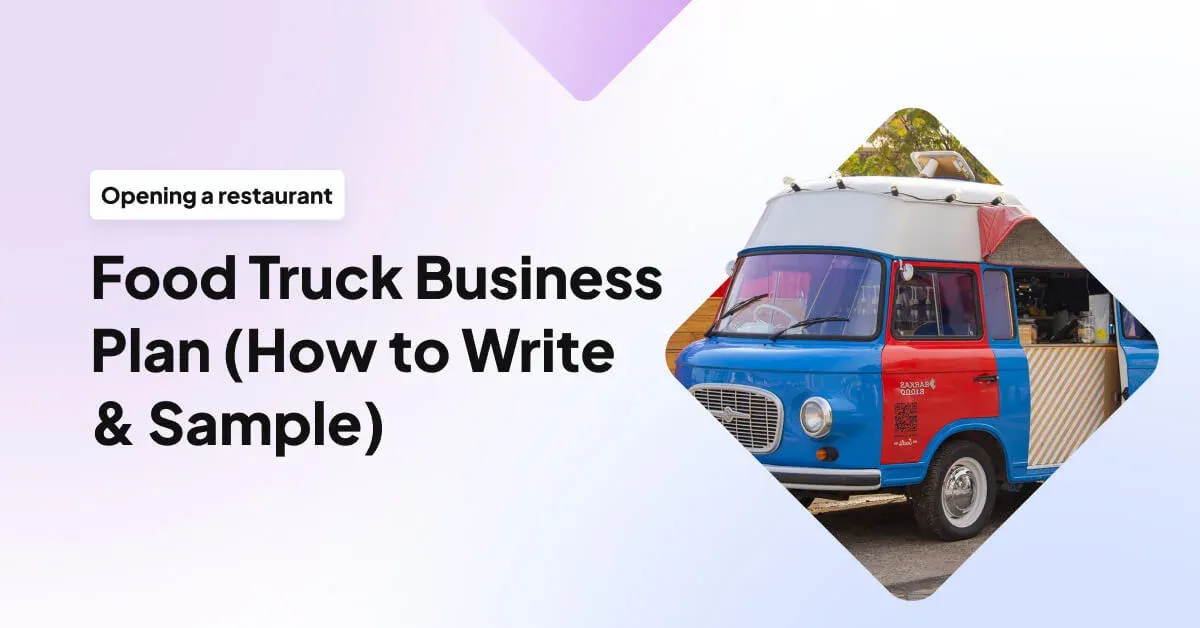
A food truck business plan is a written roadmap covering your concept, target market, menu, marketing, operations, and finances — the document a bank or investor needs before they’ll fund you.
Most trucks cost $50,000–$200,000 to launch, and a clear plan is what turns that spend into a profitable business instead of a $100k mistake.
This guide gives you the full 9-section template, a filled-in example you can adapt (meet “Foglight Kitchen”), a startup-cost breakdown with real numbers, and the break-even math investors expect to see.
1. Executive Summary
The executive summary is the beginning of your food truck business plan — a brief overview of your concept:
- Provides a reader with information on the critical aspects of your business plan, including a summary of the budget, the business’s purpose and values, and a clear idea of your product and brand.
- Is short (usually around 1–2 pages or 600 words).
What Should I Cover in an Executive Summary?
- What food will you serve?
- Where will you sell your food?
- Why do you think your food will be popular in the area you’ll be selling it?
- How much will it cost to open your food truck, and how much do you expect to make?
- What are your goals for your food truck business in the future?
2. Food Truck Description
Provide detailed information about your food truck business, including your concept, target market, and what makes your offer unique.
This section should also include your restaurant’s mission statement and explain how your food truck will stand out and bring value to the local market.
If you’re weighing a mobile concept against a fixed low-overhead kitchen, compare it with a ghost kitchen business plan before you commit.
Supporting Questions
- Why did you choose a food truck instead of a physical restaurant location?
- Where do you plan to park your food truck?
- What type of food truck will you use (truck, trailer, or food cart)?
- Will you prepare your food inside the truck or at a commissary kitchen?
- What is your production capacity?
- How will your food items compete with other food trucks or restaurants in your target area?
- What is your competitive advantage?
3. Market Analysis
While writing a business plan, provide the market analysis alongside the restaurant’s SWOT analysis. For context: the US food truck market is worth $2.8 billion across 92,257 businesses, and the core customer is aged 25–44 (about 38% of category spend).
Your market analysis shouldn’t prove that food trucks work in general — it should prove demand exists in your specific spot, at your specific hours.
The most critical factors you must cover are:
- Target market – if you plan on selling burgers, analyze if there is a need for this type of food.
- Location – strictly connected with your target market. If you sell burgers and find a location with demand for them, a university campus could be a good one.
- Competition – are there many food trucks or restaurants in your location? If yes, what do they sell, and who is their target customer? Find your niche and serve your customers according to their needs.
What you should consider
- Think about current and seasonal trends and your target customer needs.
- Describe your target customers with demographic information (age, geographic area, income level).
- Define the size and growth potential of your target market and explain how you’ll get market share.
- Analyze the competition and consider how to differentiate your business.
4. Sample Menu
Describe your food truck menu items. Since food trucks are associated with fast, reliable meals, your menu and beverage options are crucial to your brand and strategy.
- What kind of food will you serve?
- Why will customers choose to eat your food?
- Do you already have recipes, or will you develop them?
- What is your unique selling point?
5. Marketing and Publicity
Traditional restaurants have one permanent location, but food trucks change location more often — they may have a chosen spot and still attend different street food events.
That’s why a restaurant marketing strategy becomes more challenging in the food truck business and must be described in your plan.
Repeat business is where mobile food makes its margin. One UpMenu client, The Wind-Chill Factory, generates around $386,000 a year with 52% of orders coming through its own branded mobile app — no third-party platform commissions.
For a food truck, three tools do most of the heavy lifting: your own restaurant mobile app for pre-orders that beat the lunch queue, and QR code ordering at the window. A simple loyalty program turns the weekday lunch crowd into regulars.
What to cover
- Use social media to tell loyal customers where you are and build a consistent food truck branding strategy.
- Lean into uniqueness — a distinct truck design or an innovative selling point.
- Brainstorm activities to reach potential customers online and offline.
- Build a website and integrate QR code ordering.
- Consider creating your own branded mobile app.
6. Business Operations
Apart from customer service, sales, inventory tracking, accounting, and supply chain management, a food truck business plan must address operational issues like:
- Where you can park the truck
- How you’ll reach customers from that location
- Your operating hours
A food truck POS system that handles card payments, app orders, and online orders from one screen keeps the line moving during the lunch rush — the single biggest constraint on a truck’s daily revenue.
7. Financing and Startup Costs
Whether you buy or rent a food truck, it will still be cheaper than a traditional restaurant. Expect $50,000–$200,000 for a new build-out, or far less for a used truck or trailer.
The US Chamber puts the average all-in cost to open at about $55,000; some custom setups exceed $100,000. Here’s a typical startup-cost breakdown to adapt:
Cost Item | Typical Range | Notes |
|---|---|---|
Truck or trailer (used → new) | $20,000–$200,000 | Biggest single line; used trucks cut this sharply |
Kitchen equipment & build-out | $10,000–$40,000 | Grills, fryers, refrigeration, hood |
Exterior wrap & branding | $2,000–$5,000 | Your "mobile billboard" |
Generator / power | $1,000–$3,000 | Self-sufficient power for off-grid lots |
POS system & hardware | $0–$2,000+ | Card, app, and online orders on one screen |
Permits & licenses | $500–$3,000 | Varies heavily by city and state |
Commissary kitchen rent | $500–$1,500 / mo | Legal prep space (you can't prep at home) |
Insurance | $2,000–$5,000 / yr | Vehicle + general liability |
Working capital (first 3 months) | $5,000–$10,000 | Inventory, fuel, payroll buffer |
If you don’t have your own resources, look into a business loan, crowdfunding, or a business line of credit.
8. Sales Forecast, Break-Even & P&L
A break-even analysis is a key part of a new food truck business plan. It shows how much food sales are needed each month to cover expenses and reach the break-even point.
Worked example: If your truck has $6,500 in monthly fixed costs, an average ticket of $13, and $4.50 in food and packaging cost per order, your contribution margin is $8.50 per order.
Break-even = $6,500 ÷ $8.50 ≈ 765 orders per month — about 30 orders per service day. For context, food trucks run roughly a 6.8% net margin versus 1–3% for sit-down restaurants, so tight cost control on a mobile model genuinely pays off.
Next, provide a potential restaurant’s profit and loss statement, which shows the turnover and profits you’ll generate.
Finally, include a cash flow analysis to show investors how you’ll allocate funds for labor, supplies, and operations — and to demonstrate that the truck can be self-sufficient without additional investment.
9. Team and Management
Whether you’ll be the only person working in the food truck or are planning to hire a team, write about it to evaluate your staffing needs. Consider individuals with the required skills and those you’ll need to hire or train, and include the cost of necessary training in your plan.
Food Truck Business Plan Example
Here’s a condensed, filled-in version of all nine sections for a fictional truck — use it as a model, then swap in your own numbers.
1. Executive summary: Foglight Kitchen is a chef-driven food truck serving globally inspired rice bowls and loaded fries in Portland’s downtown lunch corridor and weekend brewery lots.
We open with one truck, an average ticket of $13, and a goal of 60 orders per service day. Startup capital required: $72,000, funded by $45,000 owner savings and a $27,000 SBA microloan.
2. Description: A used 22-ft truck with a commissary-kitchen partnership for prep. We chose mobile over brick-and-mortar to test three neighborhoods before committing to a lease, and to keep monthly overhead under $7,000.
3. Market analysis: The US food truck market is $2.8 billion across 92,257 businesses, and our core customer (office workers aged 25–44, 38% of category spend) clusters in the downtown core 11 a.m.–2 p.m. Two competing trucks serve tacos and BBQ; none serves rice bowls — that’s our gap.
4. Menu: Six bowls and three loaded-fry baskets, $11–$15, food cost held to ~34%. A rotating weekly special drives repeat visits and social content.
5. Marketing: Daily location posts on Instagram, a branded mobile app for pre-orders to beat the lunch queue, QR-code ordering at the window, and a points-based loyalty program for repeat lunch buyers.
6. Operations: Service Tue–Sat, 11 a.m.–8 p.m.; prep at a shared commissary; two staff per shift; a food-truck POS handling card, app, and online orders from one screen.
7. Financing: Startup costs total $72,000 (see breakdown above). We hold $8,000 working capital for the first three months.
8. Financials: With $6,500/month fixed costs, a $13 average ticket, and $4.50 food + packaging cost per order, contribution margin is $8.50. Break-even = $6,500 ÷ $8.50 ≈ 765 orders/month (~30 per service day).
At our 60-orders-a-day target, projected net margin tracks the industry’s ~6.8% in year one and improves as catering bookings grow.
9. Team: Owner-operator (head chef, 8 years restaurant kitchens) plus one part-time line cook; a bookkeeper on retainer for monthly P&L and quarterly tax filing.
Frequently Asked Questions (FAQ)
Yes — typically more than restaurants. Food trucks run about a 6.8% net margin versus 1–3% for sit-down venues, thanks to lower overhead and no long-term lease.
Yes. Banks and the SBA require a business plan to assess viability before approving financing.
It depends on your margin. With $6,500 in monthly fixed costs and an $8.50 contribution margin per order, you’d need about 765 orders a month — roughly 30 per service day.
About the author

Marketing Manager
Leads UpMenu's marketing and helps restaurants grow. Writes about restaurant marketing, branding, websites, menu design, and opening a restaurant — from pizzerias and food trucks to coffee shops and ghost kitchens. Digital marketer driven by data and AI — for 6+ years working with restaurants.