Talk to sales Contact Login English

Restaurant Mission Statement: 8 Real Examples + Free Template

Contents

A restaurant’s mission statement is one or two sentences that explain why the restaurant exists and what it stands for — the purpose behind the food, beyond simply serving a good meal.

This guide gives you 8 real mission statements from working restaurants, grouped by restaurant type, each with a short note on why it works — plus a fill-in-the-blank template and a 5-step process to write your own.

Your mission statement is also a core part of your restaurant business plan.

Key Takeaways

  • A restaurant mission statement explains why you exist in 1–3 sentences — it’s not a slogan or a tagline.
  • The strongest statements are specific to one restaurant — if a competitor could sign their name to it, rewrite it.
  • Group your inspiration by restaurant type (fast casual, fine dining, café, bar, food truck) — the right tone differs by concept.
  • Use the template below, then test your draft against four questions: is it specific, buzzword-free, short, and something you’re proud to say out loud?

What is a Restaurant Mission Statement?

A restaurant mission statement explains, in a sentence or two, why your restaurant exists and what it stands for. It guides everyday decisions — from what you buy to who you hire — and gives guests and staff a reason to choose you.

It’s not a slogan or a tagline. “Serving the freshest seafood in town” is a tagline; “Hooked from boat to table” is a slogan.

A mission explains the purpose underneath them — the reason you opened in the first place. It’s also the anchor for the rest of your restaurant branding: every color, phrase, and design choice should ladder back to it.

Mission vs. Vision vs. Values

Your mission says what you do today and why. Your vision says where you’re headed. Your values are the rules that guide how you get there.
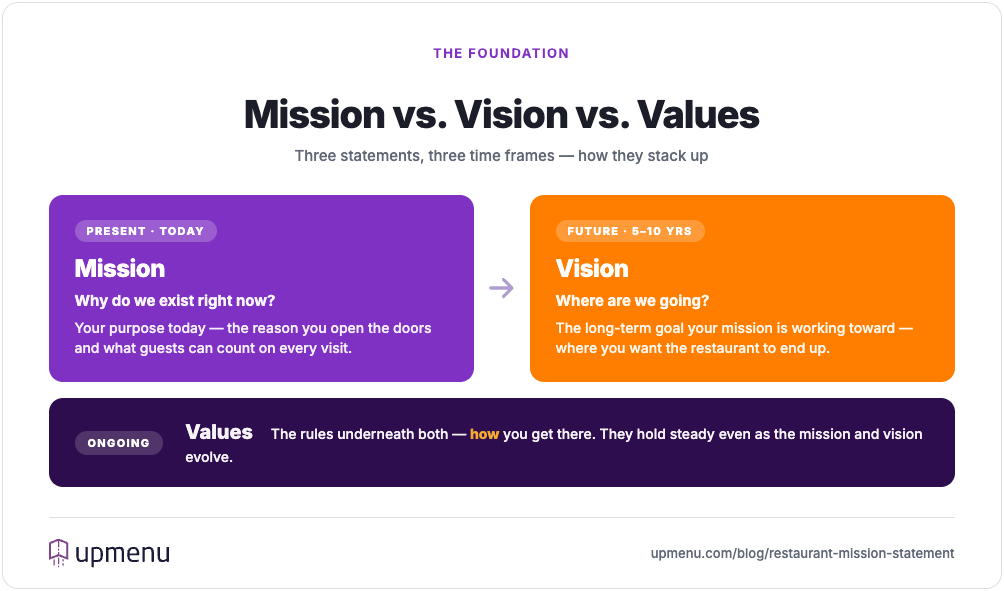
Timeline diagram comparing a restaurant's mission (present), vision (future), and values (ongoing foundation), with a family taquería example for each.

Mission Vision Values
What it is Your purpose today Your future goal The rules you operate by
Time frame Present Future Ongoing
Key question Why do we exist right now? Where are we going? How do we get there?

One worked example ties them together: a family taquería’s values might be generosity, tradition, and fair pay; its mission, to serve its grandmother’s recipes to the working families of its neighborhood; its vision, to be the table three generations keep coming back to.

Why Your Restaurant Needs a Mission Statement

Writing a mission statement rarely feels urgent — but a clear one pays off every day.

  • It gives your team direction: Your staff make dozens of small calls without you; a clear mission points them the same way, so service stays consistent whether you’re there or not.
  • It differentiates you: Every restaurant serves food. Your mission says why you serve your food, in your place — far harder to copy than a menu.
  • It helps you hire and keep the right people: A specific mission attracts people who share it — and restaurants carry one of the highest turnover rates of any industry, so anything that gives staff a reason to stay protects one of your toughest costs.
  • It guides hard decisions: Switching suppliers, adding an event, staying open late — ask one question: does this fit what we stand for? It’s the same lens you’ll use to set clear restaurant goals and run a SWOT analysis for your restaurant.

8 Restaurant Mission Statement Examples (By Type)

The best way to write yours is to see how real restaurants define their purpose — and notice how the tone shifts with the concept.
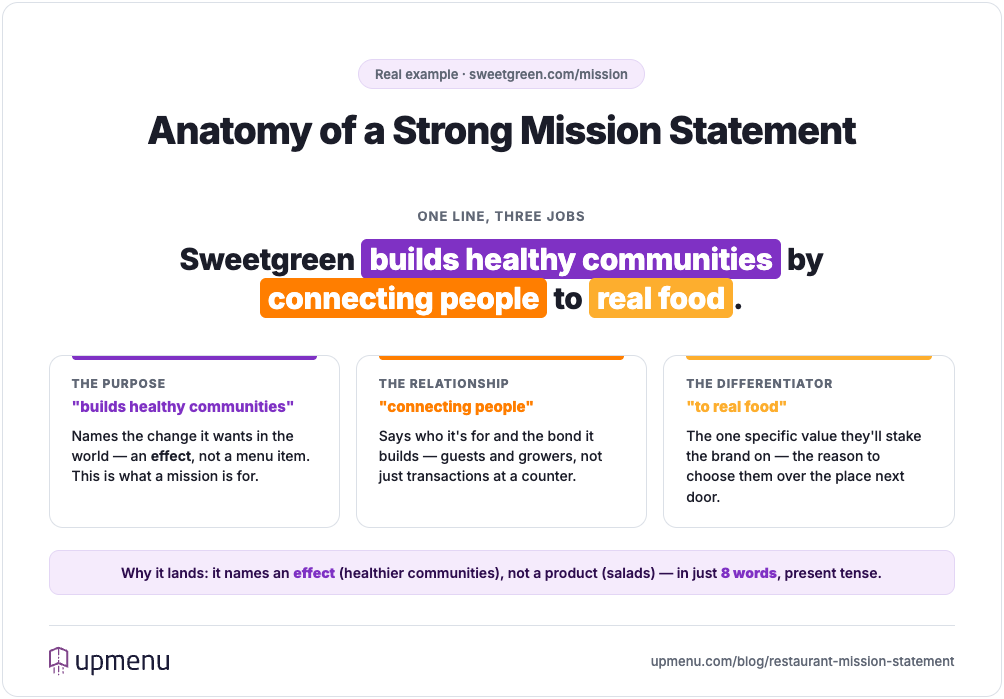
Breakdown of Sweetgreen's restaurant mission statement split into three parts — purpose, relationship, and differentiator.

Every statement below is quoted from the restaurant’s own materials; the takeaway is why each one works.

Fast casual & fast food

1. Chipotle — its purpose is to be “Cultivating a Better World.” Why it works: three words a crew member can remember mid-shift, yet specific enough to actually steer real decisions about sourcing, farming, and hiring.

2. Sweetgreen — it exists to build healthy communities by connecting people to real food. Why it works: it names the effect it wants (healthier communities), not the product (salads) — so the mission still fits as the menu grows.

3. Shake Shack — its founding mission is to “Stand For Something Good.” Why it works: a value bigger than the burger. It gives the brand room to talk about ingredients, hiring, and community under one simple banner.

Fine dining

4. Canlis, Seattle — its mission is “To inspire people to turn toward one another.” Why it works: it never mentions food, yet it governs every plate and three generations of hospitality. A mission this human is almost impossible for a competitor to copy.

Cafés & coffee shops

5. Philz Coffee — its mission is “Better Days for everyone, every day.” Why it works: nothing about beans or brewing. Philz decided early that it was in the people business, and the one-cup-at-a-time service model follows directly from that. 

Bars & sports bars

6. Walk-On’s Sports Bistreaux — it exists to bring people together over great food, sports, and a sense of belonging. Why it works: it leads with belonging, not the TVs. That’s the real reason a sports bar earns regulars — and it tells the team what the room should feel like.

Food trucks

7. Cousins Maine Lobster — it was built to share an authentic Maine experience, making high-quality lobster affordable and accessible. Why it works: it roots a mobile brand in a real place and a clear promise (authentic, affordable), so the standard travels with every truck.

Independent & family-owned

8. Zingerman’s, Ann Arbor — its mission runs several lines and ends: “…to enrich as many lives as we possibly can.” Why it works: it ties everyday food and service to a larger purpose. Staff quote the last line decades later — the surest sign a mission is doing its job.

Notice the pattern: the strongest statements name a purpose or feeling, not a product. None of them would fit any other restaurant — which is exactly what makes them work.

How to Write a Restaurant’s Mission Statement (5 Steps)

Step 1: Define your purpose beyond food: Why did you open? Sharpen it: if you closed tomorrow, what would your neighborhood lose?

Step 2: Identify 3–5 core values: The real test of a value is what you give up for it. “Support local farms” means accepting a higher invoice — if you’ll truly stick to it, keep it; if not, cut it.

Step 3: Write for three audiences: guests, staff, and community: Read your draft as a first-time guest, then as a cook deciding whether to apply, then as a neighbor weighing a partnership. If it lands for one but not the others, keep working.

Step 4: Draft, then test against four questions: Is it specific to you (would it read false if a competitor signed it)? Is it free of buzzwords? Is it three sentences or fewer? Are you proud to say it out loud?

Step 5: Refine for length and clarity: Trim to a sentence or two and read it aloud until it sounds like you — and like no one else.

The fill-in-the-blank template

Staring at a blank page? Fill in the brackets, then rework it until it sounds like you’re talking to a guest — not an investment committee:

[Restaurant name] exists to [what you do and why] for [who you serve], guided by [two or three core values]. We believe [a specific belief about your food, hospitality, or community]. Our goal is to [the concrete impact you want on guests or your neighborhood].

Example (fictional): Rook & River exists to serve wood-fired, locally sourced comfort food for the families of its river-town neighborhood, guided by warmth, patience, and fair pay. We believe a shared table makes a stronger community. Our goal is to be the place three generations keep coming back to.

How long should it be?

Keep it to one sentence up to one short paragraph. Most restaurant mission statements are 1–3 sentences and rarely exceed 100 words. If yours runs longer, it’s becoming a story for your About page — trim it back to the core purpose.

First or third person?

Both work — but they land differently. First person (“We serve…”) sounds internal and personal. Third person or a “you”-focused line (“To better people’s days…”) keeps the focus on the guest, not on you. Pick the voice that matches how you talk to customers, and stay consistent.

Common Mistakes to Avoid

A few pitfalls turn a promising mission into wallpaper. Watch for these:

  • Being too generic: Broad lines like “we serve great food” say nothing. Highlight what sets your restaurant apart.
  • Overloading with buzzwords: “Quality” and “sustainability” matter, but stacking them dilutes the message. Say what you actually mean.
  • Ignoring team alignment: Your mission should inspire staff, not just customers. A statement the team can’t see themselves in creates confusion, not motivation.
  • Neglecting the customer perspective: If it doesn’t resonate with the guests you want, it won’t do any work for you.
  • Making it too long: A strong mission is concise. Trim the extra details and keep the core purpose.
  • Forgetting to update it: As your restaurant evolves — new locations, a menu overhaul, a rebrand — revisit the mission so it still fits.

Where to Put and Use Mission Statement

Once you’ve written it, put it to work:

  • On your website — an About or Our Story page is the natural home, where guests who care about your values can find it.
  • In your business plan — your mission anchors your business plan and usually opens your restaurant executive summary, keeping every other section pointed the same way — right through to your restaurant marketing plan.
  • In your staff handbook — so the team treats it as a living part of the culture, not a line on the wall.
  • On your menu, app, and touchpoints — a clear mission helps guests connect with your brand and come back. If you run a restaurant mobile app or a loyalty program, your mission is the story that makes repeat visits feel like belonging, not just transactions.

Frequently Asked Questions (FAQ)

Both work. First person feels personal and internal; third person or a “you”-focused line keeps the focus on the guest. Choose one and stay consistent.

On your website’s About page, in your business plan, in your staff handbook, and across guest touchpoints like your menu and app.

Review it periodically and after major changes — new locations, a menu overhaul, or a rebrand — so it stays aligned with your purpose.

Yes. A clear statement of your values helps guests who share them choose you and come back, building trust and loyalty.

Together they cover both present and future: the mission says why you exist now, the vision where you’re headed — keeping branding and decisions consistent.

Picture of Dominik Bartoszek

Dominik Bartoszek

Marketing Manager at UpMenu. Leads UpMenu's marketing and helps restaurants grow. Writes about restaurant marketing, branding, websites, menu design, and opening a restaurant — from pizzerias and food trucks to coffee shops and ghost kitchens. Digital marketer driven by data and AI — for 6+ years working with restaurants.

How helpful was this post?

Share this article

More from UpMenu:

Try for free,
no commitment!

Ready to take the next step for your restaurant business?
Schedule a Demo Today! 🚀