
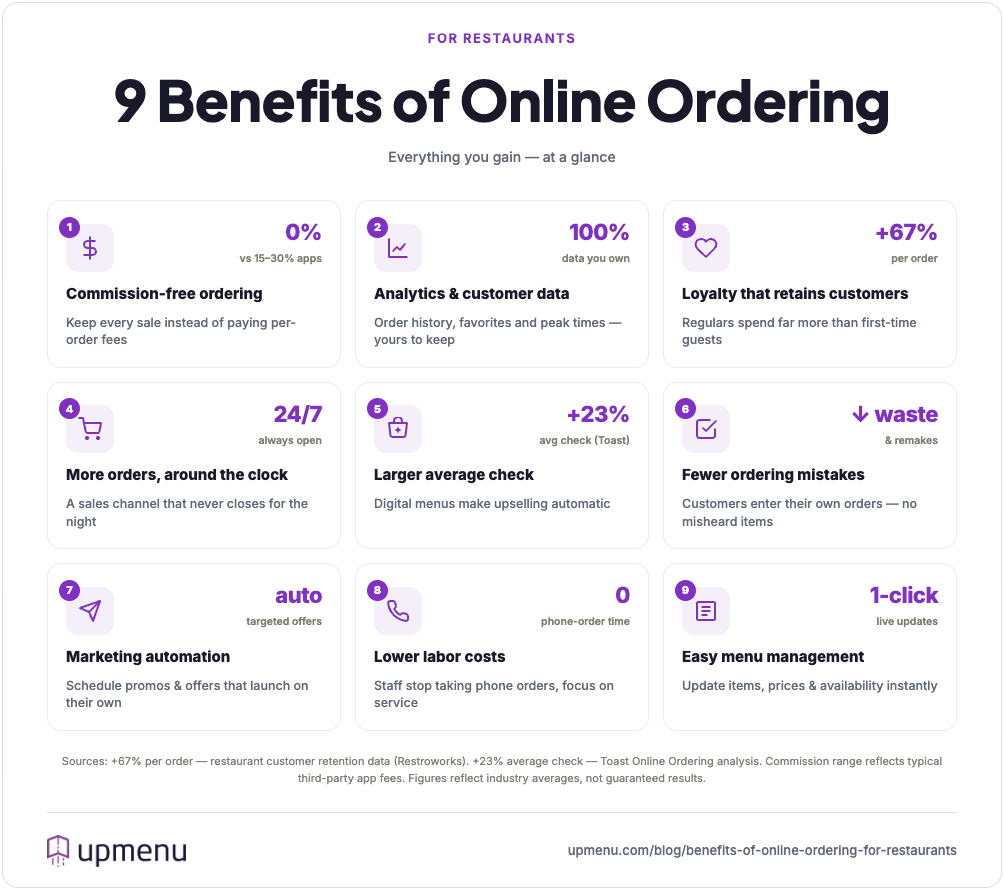
Online ordering lets your customers browse your menu and place orders directly through your website or app — no phone call needed.
For restaurants, the biggest benefits are higher revenue and average check size, fewer order errors, lower labor costs, direct access to customer data, and freedom from third-party commission fees.
Below are the 9 biggest benefits of online ordering for restaurants — each one backed by real numbers.
Key Takeaways
- Commission-free ordering: Keep 100% of every sale — third-party apps charge 15–30% per order.
- Built-in analytics: Capture customer data (order history, favorites, peak times) that you own, not the platform.
- Loyalty programs: Turn one-time guests into regulars, who spend up to 67% more per order than first-timers.
- More orders: Come in around the clock through a sales channel that never closes.
- Larger average checks: Restaurants on Toast see a 23% bigger check online than in-store, thanks to automatic upselling.
- Fewer ordering errors: Because customers enter their own orders, there is less food waste, fewer remakes, and fewer bad reviews.
- Marketing automation: Schedule promotions and targeted offers that launch to customers on their own.
- Lower labor costs: Staff stop taking phone orders and focus on food and service.
- Easy menu management: Update items, prices, and availability in seconds, with real-time order tracking for customers.
1. Commission-Free Ordering
A commission-free online ordering system lets you keep 100% of every sale — unlike third-party delivery apps such as DoorDash, Uber Eats, and Grubhub, which charge 15–30% on every order. Restaurants that take orders directly earn up to 35% more per transaction than those relying on third-party apps.
| Feature | Commission-Free System (e.g. UpMenu) | Third-Party Apps (DoorDash, Uber Eats) |
|---|---|---|
| Commission per order | 0% (flat subscription) | 15–30% |
| Customer data | You own it | They own it |
| Branding | Your restaurant | Their app |
| Customer relationship | Direct | Through the platform |
| Pricing model | Predictable monthly fee | Per-order fees |
Third-party platforms are useful when a new restaurant needs exposure. But once you have a steady customer base, those commissions only eat into your margin — the more you sell, the more you pay.
With your own online ordering system, the cost is a flat, predictable subscription instead of a cut of every order. Over 70% of diners say they’d rather order directly from a restaurant than through a third-party app, so why send them — and your profit — somewhere else?
2. Built-In Analytics & Customer Data
Every online order automatically captures customer data you’d never get from a phone call or walk-in: order history, average ticket size, favorite items, and ordering times. You own this data — it isn’t locked inside a third-party app.
With restaurant analytics, you can see who your regulars are, which dishes sell and which don’t, and when your peak hours hit.
That turns guesswork into decisions: target promotions at the right customers, adjust your menu around what actually sells, and forecast demand to staff smarter. The longer you run online ordering, the more accurate that forecasting becomes.
3. Loyalty Programs That Retain Customers
Repeat customers are where the profit is: regulars spend up to 67% more per order than first-time guests, and 65% of restaurant revenue comes from returning customers.
An online ordering system with a built-in restaurant loyalty program turns one-time orders into repeat ones automatically.
Instead of paying for expensive ads to win new customers, you reward the ones you already have — points, perks, and offers that bring them back. Loyalty members visit about 20% more often and spend roughly 20% more per visit than non-members.
Many basic ordering systems skip advanced loyalty features, so make sure yours includes them.
4. More Orders, Around the Clock
Online ordering opens a sales channel that’s available 24/7 — customers can order when your phone lines are busy or your doors are closed. You reach people who are ready to buy and primed to respond to your offers.
Digital ordering also captures high-intent demand: people land on your ordering page hungry and ready to buy, not just browsing. Pair that with add-on prompts and timed promotions, and each visit is worth more.
Pair that with add-on prompts and timed promotions, and each visit is worth more. Learn more with our guide on how to increase sales at a restaurant.
5. Larger Average Check Size
Customers spend more when they order online. Restaurants using Toast see a 23% larger average check on online orders than in-store, and over 34% of orders placed through an online ordering system are worth $50 or more.
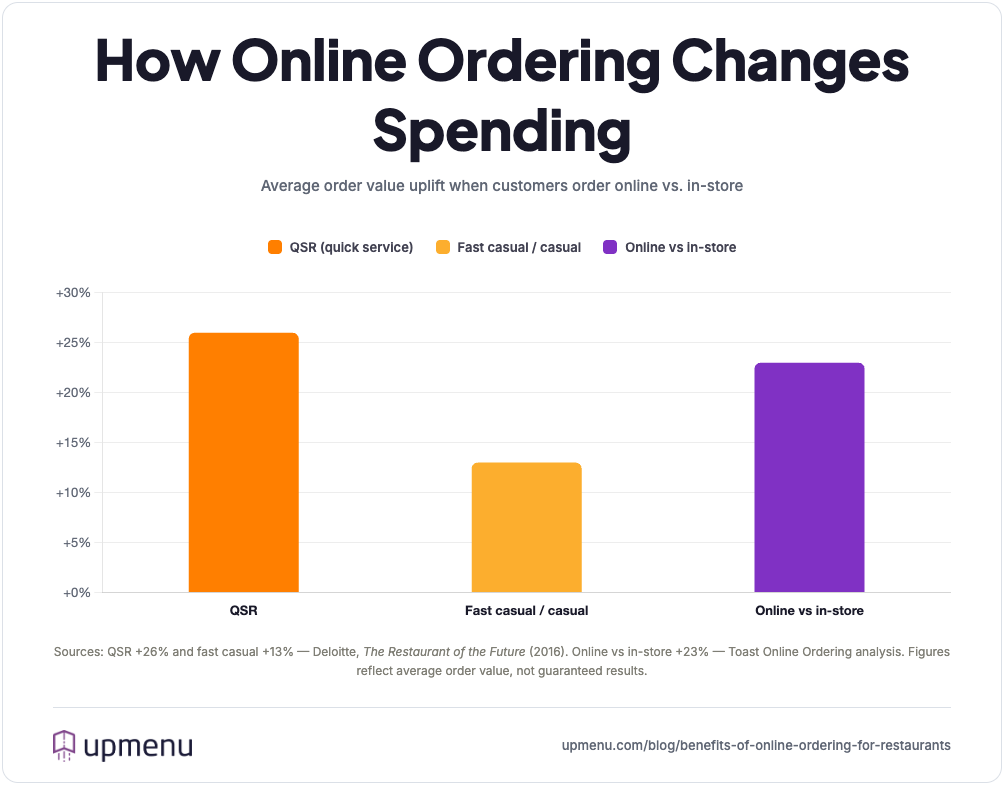
The reason is simple: a digital menu makes upselling and cross-selling automatic. Customers have time to browse the full menu without a line behind them or a server waiting, so they add the sides, drinks, and desserts they’d skip at the counter.
Smart systems prompt those add-ons at checkout, increasing the average check with zero extra staff effort.
6. Fewer Ordering Mistakes & Costly Errors
Online ordering cuts order errors because customers enter their own orders — no phone miscommunication, no misheard items, no special requests lost in a noisy kitchen.
Fewer mistakes means less food waste, fewer remakes, and fewer one-star reviews.
Phone orders are fragile: a single distraction and the order is misheard or the food goes to the wrong table. By the time the customer catches it, it’s too late — and a free remake won’t undo a bad review.
An online ordering system removes that risk entirely: the order arrives exactly as the customer typed it, straight into your kitchen queue.
7. Marketing Automation
An online ordering system lets you set promotions, daily specials, and campaigns in advance — then launch them to your customers automatically. No manual sending, no missed timing.
Schedule a happy-hour deal or a slow-Tuesday offer once, and the system delivers it to the right customers at the right moment.
Because the restaurant marketing tools already hold order history and contact data, those messages can be targeted — regulars get loyalty perks, lapsed customers get a win-back offer — without you lifting a finger during service.
8. Lower Labor Costs & Better Efficiency
When customers place their own orders online, your staff stops spending hours on the phone taking orders and reading back totals. That time goes back into the work that matters: preparing food, serving dine-in guests, and keeping service fast during the rush.
Orders arrive pre-formatted and paid, ready for the kitchen — no manual entry, no double-checking, no chasing payment.
During peak hours, online ordering absorbs volume that would otherwise overwhelm your team, so you serve more customers without adding staff. Over time, that means lower labor costs and a smoother operation.
9. Easy Menu Management & Real-Time Updates
With an online ordering system you update your menu, prices, and promotions in seconds — no reprinting, no waiting. Run out of an ingredient mid-service? Mark the dish unavailable with one click, and customers stop seeing it instantly.
The same goes for prices, seasonal items, and limited-time offers: change them once, and they’re live everywhere.
Customers also get real-time order status, so they know when food is being prepared and when it’s ready — fewer “where’s my order?” calls, and a smoother experience on both sides.
What to Look For in an Online Ordering System
Choosing the right platform matters as much as the decision to go online. Look for commission-free pricing, POS integration, built-in marketing and loyalty tools, and a system that carries your own branding rather than a third party’s.
For a full comparison of the top options, see our guide to the best restaurant online ordering system.

Frequently Asked Questions (FAQ)
What are the main benefits of online ordering for restaurants?
The main benefits are higher revenue and larger average checks, fewer order errors, lower labor costs, built-in customer data and marketing, and — with a commission-free system — no 15–30% fees from third-party apps. Customers also get the convenience of ordering anytime from any device.
How much does online ordering cost for a restaurant?
Most commission-free systems charge a flat subscription fee (typically $10–$80/month, depending on features) rather than taking 15–30% per order, as third-party apps do. With a hosted system, you also avoid app development costs. See UpMenu pricing for current plans.
Is online ordering worth it for a small restaurant?
Yes — for most restaurants it pays for itself quickly. It raises average check size (Toast reports a 23% larger check on online orders than in-store), frees staff from phone orders, and a commission-free system avoids the 15–30% per-order fees charged by third-party apps.
Does online ordering increase average check size?
Yes. Customers ordering online tend to spend more because digital menus make upselling and cross-selling automatic. Restaurants on Toast see about a 23% larger average check online versus in-store, and over a third of online orders are worth $50 or more.
How is a commission-free online ordering system different from DoorDash or Uber Eats?
Third-party apps charge 15–30% commission per order and keep your customer data. A commission-free system like UpMenu runs on a flat subscription, so you keep 100% of each sale, own your customer list, and order data — and the system carries your own branding, not theirs.
What are the disadvantages or challenges of online ordering?
The most common challenges are the high commissions of third-party apps, occasional technical issues, and managing online and in-house orders at once. These are largely solved by using your own commission-free system that integrates with your POS and consolidates all orders in one place.
What are the benefits of online ordering for customers?
Customers can order anytime from anywhere, browse the full menu without pressure, customize orders precisely, pay in advance, and track order status in real time — which means faster, more accurate service and less waiting.
Does online ordering really reduce order errors?
Yes. Because customers enter their own orders, there’s no phone miscommunication or misheard items. Orders arrive exactly as typed, which reduces remakes, food waste, and complaints.
How quickly can a restaurant set up online ordering?
With a hosted system, you can be live in 1-3 days — you add your menu, connect payments, and embed the ordering widget on your existing website. No app development or long IT project is required.
