
A restaurant business plan is a written document that defines your restaurant’s concept, target market, operations, marketing, and financial projections — the roadmap lenders and investors need before they back you.
A complete plan covers 8 core sections, and writing one pays off: entrepreneurs who finish a formal business plan are 16% more likely to reach viability.
Below you’ll find all sections explained, a free template you can copy, a real example, and fill-in financial projection tables.
Key Takeaways
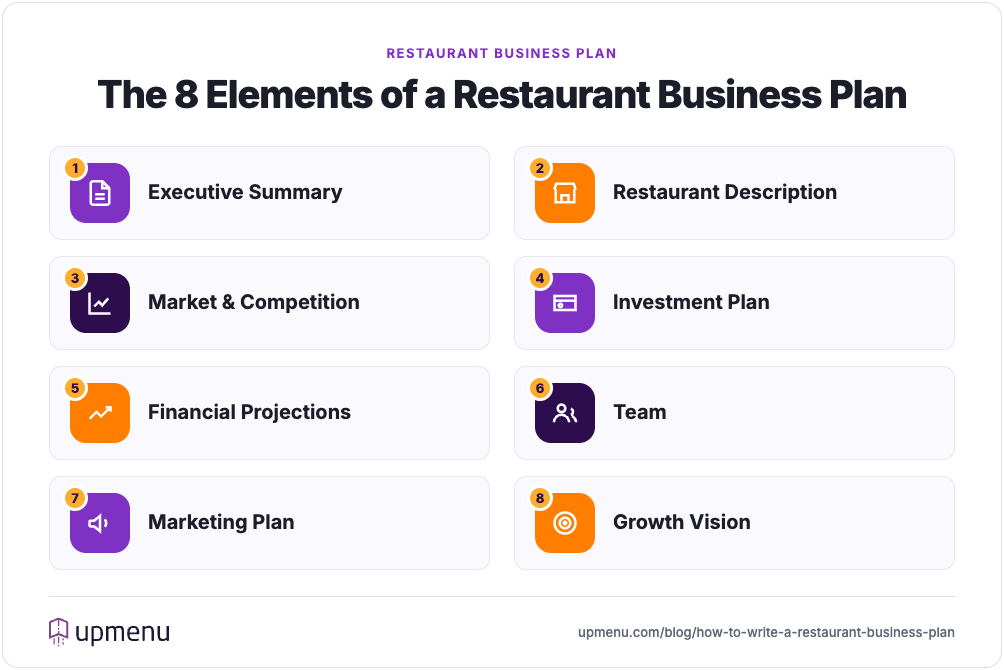
- Cover all 8 sections: executive summary, restaurant description, market & competition analysis, investment plan, financial projections, team, marketing plan, and growth vision.
- Business first, passion second. The “90% of restaurants fail in year one” line is a myth — research from the U.S. Bureau of Labor Statistics and UC Berkeley found only ~17% of full-service restaurants fail in their first year, with a median lifespan of about 4.5 years. The real killers are weak financials and poor planning — which is what this plan exists to prevent.
- Lead with numbers. Investors fund realistic projections and a clear point of difference, not enthusiasm. Fill in your P&L, break-even, and worst-case scenarios.
- Write the executive summary last and keep it to one page.
- Have an experienced restaurateur review it before you pitch — don’t outsource it.
- Treat it as a living document: review monthly while you’re opening, then at least once a year.
What Is a Restaurant Business Plan?
A restaurant business plan is a written document that describes your restaurant’s concept, market, operations, team, marketing, and financial projections. It does two jobs: it forces you to pressure-test your idea, and it’s the document lenders and investors require before funding you.
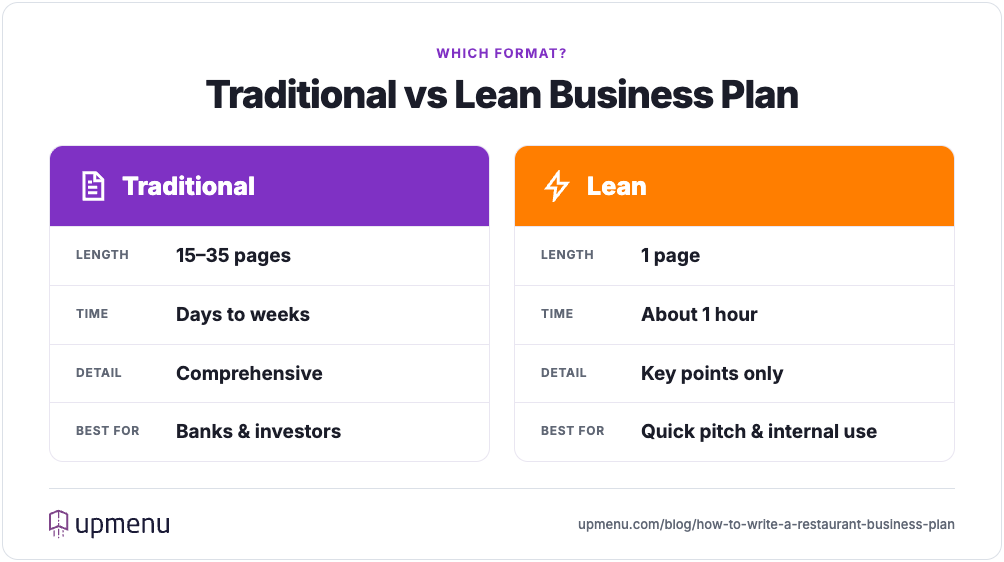
Plans come in two formats:
- Lean plan: one page, high-level, fast to write. Good for internal clarity or a quick pitch.
- Traditional plan: 15–35 pages, detailed. What banks and most investors expect.
- Restaurant Business Plan
- Fast Food Restaurant Business Plan
- Sushi Restaurant Business Plan
- Pizzeria Business Plan
- BBQ Restaurant Business Plan
- Indian Restaurant Business Plan
- Seafood Restaurant Business Plan
- Food Truck Business Plan
- Bar Business Plan
- Catering Business Plan
- Ghost Kitchen Business Plan
- Coffee Shop Business Plan
- Bakery Business Plan
- Ice Cream Shop Business Plan
Free Restaurant Business Plan Template
Use our blank template to build your plan section by section. Fill in the details in the form below to get your copy.
8 Elements of a Restaurant Business Plan
Each section below maps to the template, and there’s a complete worked example further down.
1. Executive Summary
Keep your restaurant executive summary to one page (about 500–600 words) and write it last — it should let an investor grasp your concept, market, and numbers in under two minutes.
Include:
- Restaurant mission statement, vision, and values
- Your restaurant concept
- Why the idea will work
- How you’ll implement the plan
- Estimated costs and expected profit
- Return on investment
The executive summary is the first (and sometimes only) section investors read, so it has to land. Focus on your core idea and your point of difference.
2. Restaurant Description
This section spells out what your restaurant actually is. Cover:
Concept
- Restaurant name (need ideas? Try our restaurant name generator)
- Restaurant type (bistro, fine dining, fast casual, etc.)
- Location strategy: where the restaurant is — or could be — and why
- Style: colors, atmosphere, décor, music
- Service model: dine-in, delivery, or both
- Opening hours, and the reasoning behind them
Structure
- Legal form: sole proprietorship, partnership, LLC, etc.
Menu
- Type of cuisine
- A draft menu, priced using the rules of menu engineering
- 1–3 differentiators from the competition (your USPs)
Briefly outline day-to-day operations too — kitchen workflow, front- and back-of-house roles, suppliers. For the full launch checklist, see our guide on opening a restaurant.
3. Market Research and Competition Analysis
Before you commit, analyze the market and the competition you’ll face.
Market analysis
Understanding your customers’ demographics, preferences, and dining habits is the foundation of the whole plan.
- Target market: who your customers are — age, interests, expectations, and how to reach them. (See how to define restaurant target market.)
- Market needs: the gap you’ll fill.
- Market size: how many potential customers you can realistically reach.
- Trends: current food trends and where the industry is heading, backed by credible sources.
Competition analysis
Map the restaurants that are — or could be — your competition:
- Key competitors in your area
- Their estimated revenue and order volume
- Their menu and prices (estimate their food cost vs yours)
- Their marketing, and where they’re weak
- Your competitive advantage
Use this table to compare yourself against the field:
| Your restaurant | Competitor 1 | Competitor 2 | Competitor 3 | |
|---|---|---|---|---|
| Number of seats | ||||
| Type of menu | ||||
| Menu prices | ||||
| Marketing activities | ||||
| Service options | ||||
| Opening hours | ||||
| Additional notes |
SWOT analysis
SWOT stands for Strengths, Weaknesses, Opportunities, Threats. Strengths and weaknesses describe your launch position today; opportunities and threats describe the future. Map them in a simple grid:
| Positive | Negative | |
|---|---|---|
| Internal | Strengths | Weaknesses |
| External | Opportunities | Threats |
For a full walkthrough with examples, see our restaurant SWOT analysis guide.
4. Investment Plan (Cost Analysis)
Split your costs into two clean groups.
| One-off investment costs (to open) | Recurring operating costs (monthly) |
|---|---|
| Real estate purchase or lease deposit | Rent and utilities (electricity, gas, water) |
| Renovation and fit-out | Staff wages (chef, cooks, servers, dishwashers) and employee insurance |
| Kitchen equipment (oven, stove, fridge/freezer, dishwasher, small appliances, cookware) | Food and beverage cost |
| Furniture and décor (tables, chairs, lighting, signage, staff uniforms) | POS and online-ordering subscriptions |
| POS software and payment terminals — see restaurant POS systems | Third-party delivery commissions |
| Logo, website, and menu design | Maintenance and servicing |
| Licenses and permits (e.g., alcohol license) | Marketing (online and offline, social, SEO) |
| Legal/organizational setup and opening insurance | Taxes and fees |
For real benchmark numbers, see how much it costs to open a restaurant. Re-check your costs at least once a month after opening.
How to finance the opening of a restaurant
Securing money is the biggest hurdle for first-time owners. Options include bank loans, grants/subsidies (which require a business plan), and loans from friends and family.
Before borrowing, model the worst case: if the business stalls, can you repay? Weigh your startup costs against your margin per dish to gauge the real return. See our guide to restaurant loans and financing options.
5. Financial Projections
Your financial forecast has three parts:
- Projected profit & loss (P&L): the turnover and profit you expect.
- Break-even analysis: when the restaurant becomes profitable.
- Sensitivity analysis: what happens in bad scenarios (e.g., a 50% turnover drop for three months).
Profit and loss statement
Estimate sales from your size, target market, order volume, and food cost, then compare against costs. The easiest format is a table (filled with real numbers in the worked example below):
| Month | Month 1 | Month 2 | Month 3 | … |
|---|---|---|---|---|
| Orders per month | ||||
| Average order value | ||||
| Monthly turnover | ||||
| Variable costs | ||||
| Fixed costs | ||||
| Profit | ||||
| Profit margin (%) |
For realistic targets, check the average restaurant profit margin.
Break-even analysis
Break-even is the monthly revenue at which you cover all fixed and variable costs — the point where you stop losing money. Calculate it as:
Break-even revenue = fixed costs ÷ (1 − variable cost ratio)
Show how you’ll hit that number even in slower months.
Sensitivity analysis
Stress-test negative scenarios — a stronger competitor, losing a key employee, a 10–20% sales drop — so a crisis doesn’t catch you off guard.
6. Team
Business is people. Split your team into founders and employees.
Founders — critical if you’re raising money. List each founder, their experience, and their track record.
Employees — decide which restaurant positions are essential day-to-day and which can be part-time. Note who you already have, who you’ll hire, and any training costs (include them in your budget). For each role, describe: job title, duties, pay, and contract type.
7. Restaurant Marketing Plan
Lay out how you’ll promote the restaurant before and after opening, and which channels you’ll use. Our guide on restaurant marketing strategies shows how to execute each one.
A strong plan covers:
- Brand building — logo, colors, slogan
- Your own website with direct online ordering as your main online sales channel (commission-free, unlike third-party apps)
- Third-party delivery apps as a secondary add-on
- A loyalty program to bring guests back
- Offline outreach — flyers, local PR, events
- Online outreach — social media, SEO, Google Business Profile, email/SMS, paid Google and Facebook ads, and promotions
The point of difference here matters: every order through your own website is an order you don’t pay commission on.
8. Vision for Further Development
Set your direction from day one. Define your long-term goals, then break them into daily objectives. Reassess as you go — adapt the menu, service, and marketing to cut losses and improve. Your plan should make the vision and the path to it explicit.
Restaurant Business Plan Example
The following is a condensed sample for a fictional restaurant, to show how each section reads once it’s filled in.
Executive summary: Brick & Bloom Bistro is a 45-seat farm-to-table bistro in Austin, TX, serving seasonal American plates at a $22–28 average check. We project break-even in month 9 and a 12% net margin by year two, funded by $220,000 (owner equity $90,000 + a $130,000 SBA loan).
Restaurant description: A casual-upscale neighborhood bistro, open Tue–Sun, dine-in plus commission-free online ordering for pickup. Differentiators: a rotating seasonal menu, a sub-15-minute lunch guarantee, and a loyalty program.
Market & competition: Target market: professionals 28–45 within a 2-mile radius (~18,000 residents). Three direct competitors; none offer a fast lunch guarantee or direct online ordering.
Investment plan: Build-out $95,000; kitchen equipment $48,000; furniture & décor $22,000; POS + online ordering setup $4,000; licenses & permits $9,000; pre-opening marketing $7,000; working capital $35,000.
Financial projections (year 1, monthly average once stabilized):
| Metric | Value |
|---|---|
| Orders per month | 1,200 |
| Average order value | $24 |
| Monthly turnover | $28,800 |
| Variable costs | $11,500 |
| Fixed costs | $14,000 |
| Monthly profit | ~$3,300 |
| Profit margin | ~11% |
| Break-even point | ~$26,000 / month |
Team: Two founders (chef-owner + GM), 1 sous chef, 3 line cooks, 4 servers, 2 dishwashers.
Marketing plan: Own website with direct online ordering as the primary channel, Google Business Profile, a loyalty program, a local-influencer launch, and email/SMS.
Vision: Reach a 12% net margin in year two, then open a second location in year four.
14 Questions to Help You Start
Answer these before you write — your answers feed straight into the plan:
- Why this restaurant?
- How much do you want to earn per month?
- How many guests will you serve per month?
- What type of restaurant is it (pizzeria, bistro, etc.)?
- What service model — on-site, takeout, delivery?
- What area will you operate in?
- Who is your customer?
- How many direct competitors are nearby?
- How will you stand out?
- Who do you need to hire to open?
- Which metrics will you track (food cost, traffic, reviews)?
- What will the interior look like?
- What’s the atmosphere?
- What’s on the menu?
Presenting Your Business Plan to Investors
Once your plan is written, know it inside out — investors expect you to speak fluently about every part of the business without reading from notes.
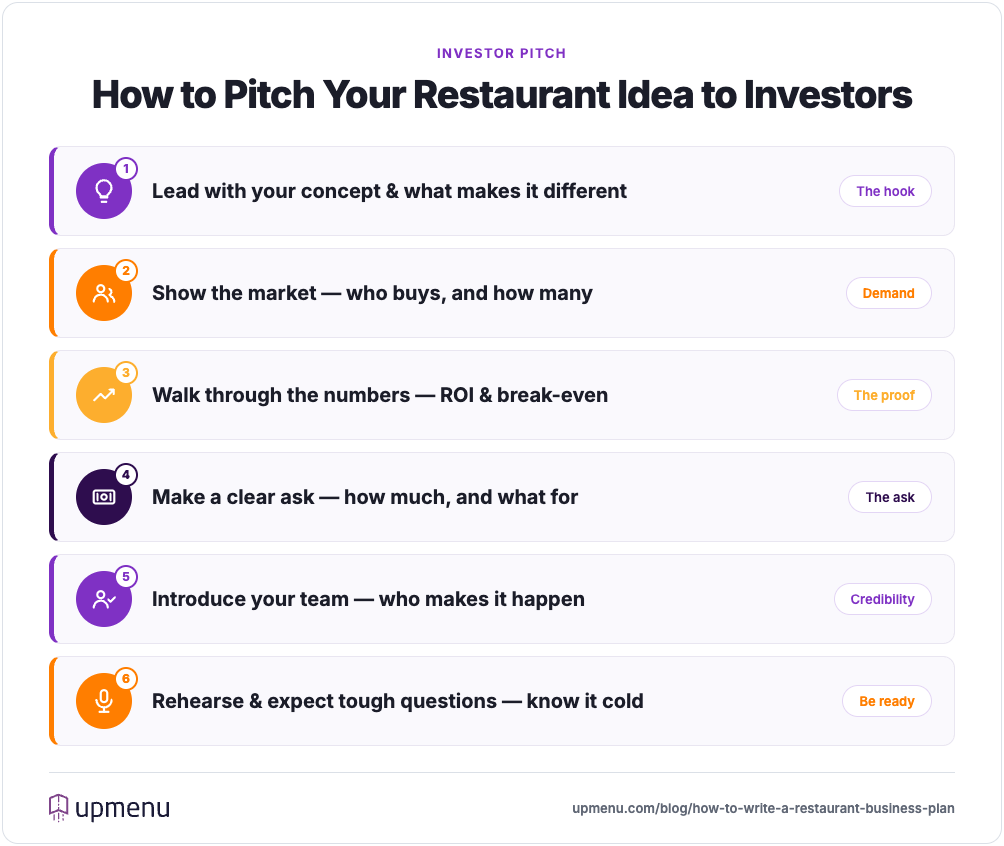
Prepare and rehearse a pitch, and anticipate likely questions. If one comes up that you can’t answer, don’t improvise — say you’ll follow up promptly, then do.

Frequently Asked Questions (FAQ)
How long should a restaurant business plan be?
A traditional plan runs 15–35 pages; a lean one-page plan works for internal use or a quick pitch. Banks and investors usually expect the traditional format.
Do I need a business plan to get a restaurant loan?
Yes. Banks and most investors require a written plan with financial projections before approving funding.
What financial projections do investors want to see?
A projected profit and loss statement, a break-even analysis, and a sensitivity (worst-case) analysis, usually monthly for the first year.
Can I use AI to write my restaurant business plan?
AI can draft a structured first version fast, but you must verify every number, localize the market data, and add your own concept and financials.
What's the most common reason restaurant business plans fail to get funded?
Weak or unrealistic financials and a vague concept — investors fund numbers and differentiation, not passion alone.
